Crappie Fishing Techniques for Beginners
You hear the stories every spring: a neighbor comes back from Buggs Island Lake with a cooler full of slab crappie, while you spent the same morning watching a motionless bobber. Crappie are one of the most rewarding fish in Virginia, but they can be maddening for beginners. This guide breaks down the gear, techniques, seasons and places that turn a first crappie trip into a full stringer.
Understanding Crappie Before You Cast
Most beginner frustration with crappie comes from one simple problem: people fish where they think crappie should be, not where crappie actually are. Crappie are schooling fish that relate tightly to cover, water temperature and baitfish. When you understand those three things, the techniques in the rest of this guide start to make sense.
I spent my first few seasons chasing crappie on Virginia reservoirs by throwing a jig at random shorelines and hoping. Once I started thinking like a crappie, paying attention to where the water was warming, where the shad were and where the brush was, my catch rate went from a few fish a trip to dozens. You can skip most of those wasted years by starting with the basics below.
Black Crappie and White Crappie
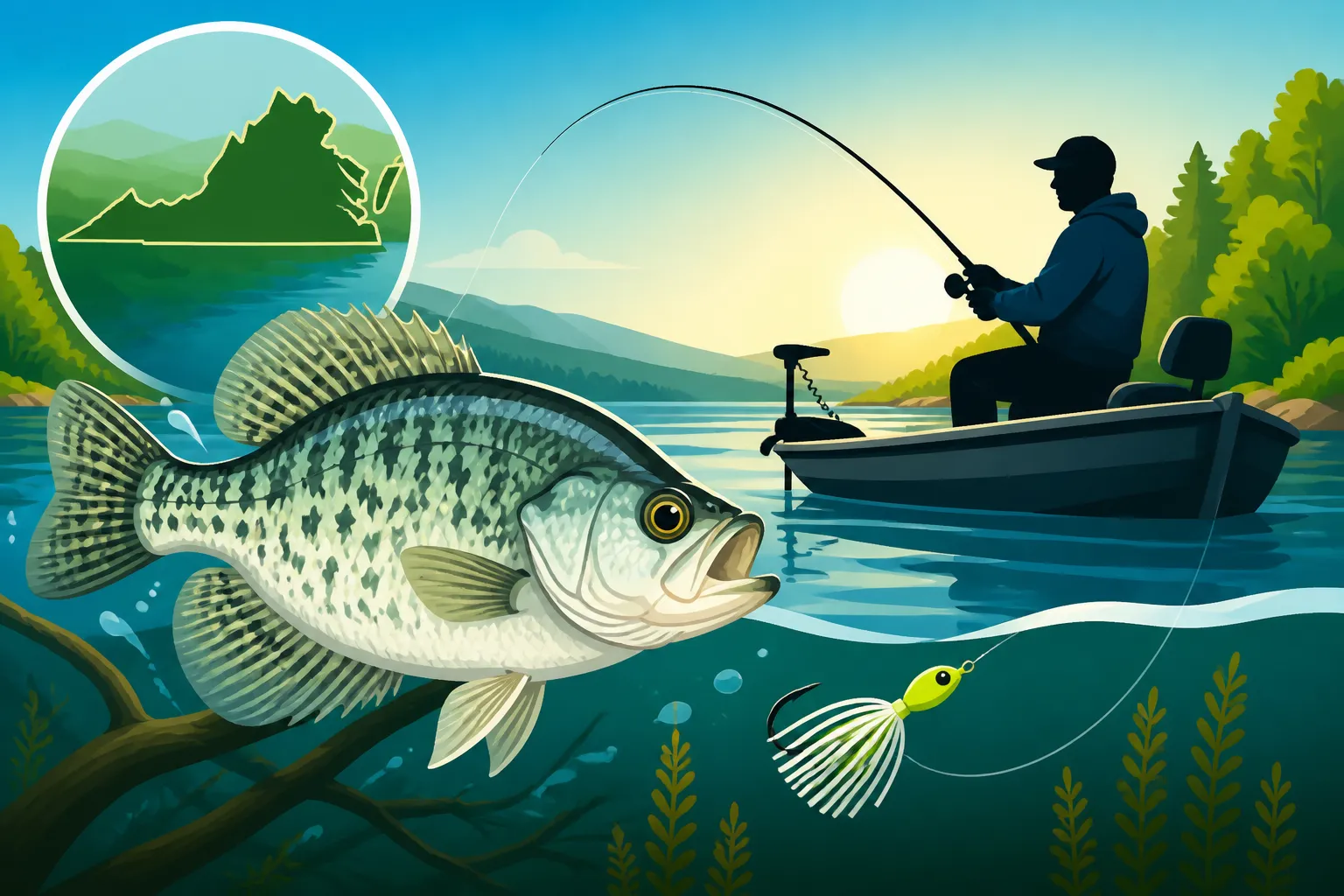
Virginia has two species of crappie, and you will catch both in many lakes. Black crappie have irregular, speckled dark blotches scattered across their sides and usually seven or eight spines in the dorsal fin. White crappie are lighter, with dark vertical bars running down their sides, and they usually have five or six dorsal spines. White crappie also tend to have a longer, more slender look.
Why does it matter? Black crappie often prefer clearer water with more vegetation and cover, while white crappie are more tolerant of stained or murky water and open-water habitats. In practice, many Virginia reservoirs hold both, sometimes in the same brush pile. Knowing which species dominates your lake helps you choose locations and colors. For a closer look at the differences, read Crappie Identification: Black Crappie vs White Crappie in Virginia.
Both species are delicious, and the regulations generally treat them together, so you do not need to separate them in your cooler. But learning to tell them apart is a fun skill and helps you understand the water you are fishing.
How Water Temperature Drives Crappie Behavior
Water temperature is the single most important factor in where crappie live and how they behave through the year. Crappie are cold-blooded, so their metabolism, feeding activity and spawning all follow the thermometer.
Here is a simple way to think about it:
| Water temperature | Typical crappie behavior | What it means for you |
|---|---|---|
| Below 50 degrees F | Slow, deep, schooled near channels and deep cover | Fish slowly and vertically in deeper water |
| 50 to 58 degrees F | Pre-spawn, moving toward creeks and staging areas | Fish creek channels and transition areas |
| 58 to 68 degrees F | Spawning in shallow cover | Fish shallow brush, docks and wood with jigs and minnows |
| 68 to 75 degrees F | Post-spawn, moving back to deeper brush | Fish brush piles and dock edges at mid-depths |
| Above 75 degrees F | Summer pattern, deep brush, docks, bridges and suspended over channels | Fish deeper cover, shade, and early or late in the day |
| Falling from 70s to 50s | Fall feeding on baitfish, scattered and roaming | Follow the shad, fish creeks and brush |
A cheap water temperature gauge, whether it is on your fish finder or a simple handheld thermometer, is one of the best tools a beginner can own. Many anglers get one through Amazon or a local tackle shop along with their first jigs. When the surface temperature starts climbing through the 50s in spring, you know the best fishing of the year is coming.
What Crappie Eat
Crappie are predators, and in most Virginia reservoirs their main diet is small baitfish, especially threadfin and gizzard shad, along with minnows and small sunfish. They also eat aquatic insects, small crustaceans and zooplankton, especially when they are young.
This is why small minnows and minnow-imitating jigs are the classic crappie baits. When you choose a jig, think about the size and color of the shad in your lake. In the fall, when crappie are chasing young-of-the-year shad, a 1.5 to 2-inch jig is often perfect. In winter, when fish are lethargic, smaller and slower baits often work better.
Crappie also have a unique way of feeding: they often strike from below, rising up to take a bait that is slightly above them. That is why keeping your bait just above the fish, rather than below them, is one of the most important rules of crappie fishing. A bait dragged along the bottom under a school of suspended crappie will often go completely ignored.
Beginner Gear That Actually Works
One of the great things about crappie fishing is that it does not require expensive equipment. A simple, light setup will catch fish anywhere in Virginia. The key is choosing gear that lets you feel light bites and present small baits naturally.
Rods and Reels
For most beginners, a light or ultralight spinning rod between 5.5 and 7 feet long, paired with a small spinning reel, is the perfect starting point. A light rod lets you cast small jigs, feel delicate bites and enjoy the fight of a 10-inch crappie. Crappie have thin, papery mouths, so a rod with a softer tip also helps prevent tearing the hook out during the fight.
As you advance, you may want longer rods. Many crappie specialists use 10 to 16-foot rods, often called jigging poles, for vertical fishing around brush and docks and for spider rigging. These long rods allow you to place a bait precisely into cover while keeping the boat further away from the fish. But for your first season, a simple light spinning combo is all you need.
Your reel matters less than your rod, but a few details help. A small spinning reel in the 500 to 1000 size class balances nicely on a light rod and holds plenty of 4 to 6-pound line. Set the drag light enough that a strong pull from a big crappie slips line rather than tearing the hook free. Many beginners lose their best fish of the day because the drag is cranked down tight from the factory. Before your first trip, pull line off the reel by hand and adjust the drag until it slips with steady, moderate pressure.
Also, do not overfill the spool. Light line that comes off the reel in loops and tangles usually means the spool was filled too close to the lip. Leave about an eighth of an inch of space at the edge and your casts will be smoother.
Here is a quick comparison of popular rod options.
| Rod type | Length | Best use | Beginner friendly |
|---|---|---|---|
| Ultralight spinning rod | 5 to 6.5 feet | Casting small jigs, bobber fishing from shore or boat | Yes |
| Light spinning rod | 6 to 7 feet | All-around crappie fishing, casting and jigging | Yes |
| Long jigging pole | 10 to 12 feet | Dipping jigs into brush, docks and timber | Moderately |
| Spider rigging rods | 12 to 16 feet | Slow trolling multiple rods from the front of the boat | Better after experience |
| Cane pole or telescoping pole | 8 to 14 feet | Simple bobber and minnow fishing | Yes |
Line, Hooks and Jigs
Line choice matters more than many beginners realize. Light monofilament in the 4 to 6-pound range is easy to handle and works well for most crappie fishing. Some anglers prefer high-visibility line so they can watch for subtle line movement when a crappie takes a falling jig. Others like fluorocarbon in clear water because it is less visible to fish.
For hooks, light wire Aberdeen hooks in sizes 2 to 6 are the classic choice for minnows. They are thin enough to hook a crappie easily and will often bend free when snagged in brush, which saves you from losing rigs.
Jigs are the heart of crappie fishing. The most common setup is a small lead jig head, usually from 1/32 to 1/8 ounce, paired with a soft plastic body. Popular plastic shapes include curly tail grubs, tube jigs, paddle-tail minnows and straight-tail baits. Hair and marabou jigs are also effective, especially in cold water. Many beginners buy assortments of jig heads and soft plastics through Amazon, which is a convenient way to try several colors and shapes without spending much. If you want a deeper discussion of live and artificial baits, see Best Bait for Crappie Fishing in Virginia.
Choosing Jig Colors Without Overthinking
Walk into any tackle shop in Virginia and you will see a wall of crappie plastics in every color imaginable. It is easy to get overwhelmed. The truth is that a small handful of colors will catch crappie almost everywhere, and the rest are mostly for fine-tuning once you know what you are doing.
A simple starting kit looks like this. For clear water, carry natural shad colors such as white, silver, pearl and smoke with a little blue or chartreuse. For stained water, carry brighter combinations like chartreuse and white, pink and white, or black and chartreuse. For very muddy water or low light, carry darker colors such as black, purple or junebug, which create a strong silhouette. With those three groups you can cover nearly any condition you will face on a Virginia reservoir.
When fishing with a partner, start with two different colors and see which one gets bit first. Once a pattern emerges, both of you can switch. Color does matter on some days, but depth and location matter far more. A perfect color in the wrong spot will not catch fish, while an average color in front of a hungry school usually will.
Bobbers, Sinkers and Accessories
A slip bobber or small fixed bobber is one of the easiest ways for a beginner to catch crappie. It suspends your bait at a precise depth and gives you a clear visual signal when a fish bites. Slip bobbers are especially useful because you can fish deeper water without struggling to cast a long length of line.
Other useful accessories include:
- Split shot sinkers to help minnows reach the right depth.
- A minnow bucket with an aerator to keep live bait healthy.
- A small tackle box with dividers for jigs, plastics and hooks.
- A pair of needle-nose pliers for unhooking fish.
- A landing net, since crappie mouths tear easily.
- A cooler or livewell if you plan to keep fish for the table.
- A simple marker buoy to mark brush piles or schools you find.
None of this needs to be fancy. Most of it fits in a small bag and can be purchased for a modest price at tackle shops, sporting goods stores or online. Keep things simple and add gear as you learn what you actually use.
Core Crappie Techniques for Beginners
Once you have your gear, it is time to learn the techniques. These four methods will catch crappie almost anywhere in Virginia. Start with the first two, then add the others as you gain confidence.
Bobber and Minnow Fishing
This is the classic, time-tested way to catch crappie, and it is still one of the best. It works from shore, from a dock or from a boat, and it is ideal for kids and beginners.
- Tie a light wire hook to your line.
- Add a small split shot about 12 inches above the hook.
- Attach a bobber above the split shot, set to the depth you want to fish.
- Hook a live minnow lightly through the lips or just behind the dorsal fin.
- Cast near cover such as brush, docks, standing timber or fallen trees.
- Watch the bobber. When it moves sideways, dips or disappears, reel in slack and lift the rod smoothly.
The most common mistake is setting the bobber too deep. Remember that crappie feed upward, so set your bait at or slightly above the depth where you think the fish are. If you are not getting bites, adjust the depth by a foot or two at a time until you find them.
When crappie are biting well, a bobber and minnow can be almost unfair. I have watched kids at Lake Anna docks catch fish on nearly every cast in April using nothing more than a bobber, a hook and a minnow. That is exactly why it is the best place to start.
Rigging a Slip Bobber
A slip bobber deserves its own explanation, because it opens up deeper water that a fixed bobber cannot reach. The bobber slides freely on the line until it hits a small knot or bead you set at your chosen depth. When you cast, the bobber sits near the hook, which makes casting easy. When the rig lands, the line slides through the bobber until the stopper reaches it, and your bait settles at the exact depth you set.
To rig one, thread a bobber stop onto the line first, then a small bead, then the slip bobber, then tie on your hook and add a split shot. Slide the stopper up or down to change depth. This lets you fish a minnow 12 or 15 feet down over a brush pile from a dock or the bank, which is often exactly where crappie hold after the spawn.
Casting and Retrieving Jigs
Casting a small jig and retrieving it slowly is one of the most versatile crappie techniques. It allows you to cover water and find active fish. The basic method is simple: cast, let the jig sink to the desired depth by counting down, then reel slowly and steadily.
The countdown method is the key to success. After your jig hits the water, count slowly as it sinks. If you get a bite on the count of five, you know the fish are at that depth, and you can count to five on every cast. A jig falling at about a foot per second is a good rule of thumb for many light jig heads, though weight, plastic shape and line diameter all affect sink rate.
Vary your retrieve until you find what crappie want. Sometimes a slow, steady swim works best. Other times, small twitches and pauses trigger more strikes. Pay attention to your line during the fall, as many crappie hit the jig as it sinks. If the line twitches, stops or moves sideways, set the hook.
Vertical Jigging Around Cover
Vertical jigging is the most effective way to catch crappie that are holding tight to brush piles, standing timber, bridge pilings or dock supports. Instead of casting, you lower the jig straight down into the cover and work it at a precise depth.
To vertical jig, position your boat directly over or beside the cover, lower your jig to the depth of the fish, and hold it still or give it small lifts and drops. Many bites come when the jig is sitting still. Crappie will often rise up and inhale the bait, and you may feel only a slight tap or notice the line going slack.
This technique works especially well in summer and winter, when crappie hold tightly to deeper cover. It is also very effective around bridge pilings on large reservoirs like Buggs Island and Lake Gaston. A long jigging pole makes vertical fishing easier because you can place the bait precisely without moving the boat right on top of the fish.
Slow Trolling and Spider Rigging
Once you have mastered the basics, slow trolling can help you cover water and find scattered schools. Spider rigging is a popular method in which anglers set multiple long rods in holders at the front of the boat, spread out like spider legs, each with a jig or minnow at a different depth. The boat moves very slowly, often with a trolling motor, pulling the baits through areas where crappie suspend.
Another popular trolling method is long-line trolling, in which you cast jigs well behind the boat and pull them slowly at a set speed. The depth of the jigs depends on their weight, the line diameter, the distance behind the boat and the speed.
These methods are very effective in fall and early spring, when crappie are scattered along creek channels and flats. Before using multiple rods, check Virginia’s current regulations on the number of rods allowed per angler, as rules can vary by water body.
Shooting Docks Step by Step
Dock shooting looks intimidating when you watch a skilled angler do it, but it is a learnable skill that can catch crappie when nothing else works. The idea is to skip a small jig far back into the shade beneath a dock, where crappie hide during the heat of the day and after the spawn.
- Use a 5 to 6-foot light spinning rod with 4 to 6-pound line.
- Open the bail and let out enough line so the jig hangs just below the rod’s first guide.
- Hold the line against the rod with your finger and pinch the jig head carefully by the bend, keeping the hook point away from your fingers.
- Point the rod tip at the dock and pull the jig back to load the rod like a bow.
- Release the jig and lift your finger off the line at the same time so the jig shoots low across the water and under the dock.
- Let the jig fall on a slack line and watch for a twitch or jump that signals a bite.
- Swim the jig back slowly, letting it fall again near support posts and shaded corners.
Practice in your backyard or on an empty dock before trying it near expensive boats. Start with short distances and work your way back. Once you get the feel, you will be reaching fish that other anglers simply cannot.
Seasonal Crappie Patterns in Virginia
Virginia’s climate gives crappie anglers a long season. In many reservoirs, crappie can be caught every month of the year if you understand where they go. Here is how the seasons typically play out across the state, from the Piedmont reservoirs to the coastal lakes.
Winter Crappie
In winter, crappie usually move to deeper water near main lake channels, creek channels and deep brush piles. They often suspend in large schools, sometimes 15 to 30 feet deep or more. Their metabolism slows, so they feed less aggressively, but they still bite.
Winter crappie fishing calls for slow, precise presentations. Vertical jigging small jigs or minnows directly over schools located with a fish finder is the most effective method. Many anglers find excellent winter fishing around deep bridges and channel bends. Be patient, fish slowly and dress warmly. Some of the biggest crappie of the year are caught in the cold months, when the fish are heavy and schooled up.
Spring: Pre-Spawn and Spawn
Spring is the best and most exciting time for crappie fishing in Virginia. As water temperatures rise into the 50s, crappie move from deep wintering areas into creeks and toward shallow spawning areas. During the pre-spawn, they stage along creek channels, secondary points and brush in moderate depths.
When water temperatures reach the upper 50s and low 60s, crappie move shallow to spawn in brush, wood, docks, stumps and vegetation. Males build nests and guard them, and both males and females can be caught in very shallow water. This is when bobbers and minnows, small jigs and shoreline fishing are most productive. In much of Virginia, the peak spawning period often falls in late March through April, though timing varies by region and year, with southern and eastern waters often warming earlier than mountain lakes.
During the spawn, crappie are at their most vulnerable, and the shallow fish are easy to catch in big numbers. It is perfectly legal to keep crappie within the limits during this period, and many families build their whole year of fish fries around spring trips. Still, it is worth taking only what you will actually eat and releasing the biggest females when you can, since they carry the most eggs and help keep a lake’s crappie population strong for years.
The best guide is water temperature, not the calendar. A cold spring can delay the spawn, while a warm one can push it earlier. For a deeper discussion, see Best Time of Year for Crappie Fishing in Virginia.
Summer Crappie
After the spawn, crappie gradually move back to deeper water. In summer, they relate to deep brush piles, docks with deep water nearby, bridges, standing timber and channel edges. They may suspend in the thermocline or near shade.
Summer crappie fishing can be challenging, but it can also be excellent. Focus on deeper cover and shaded areas, and fish early in the morning or late in the evening. Night fishing under lights is a popular summer tactic on many Virginia lakes. Anglers anchor near bridges or deep cover, set floating lights or submersible lights to attract baitfish, and then fish minnows or jigs as crappie move in to feed.
Night Fishing Under Lights
Night fishing is one of the most enjoyable ways to beat summer heat, and it works on many Virginia reservoirs. The idea is simple: light attracts plankton, plankton attracts baitfish and baitfish attract crappie. Anglers anchor near bridges, deep docks or channel edges after dark, place lights on or in the water and wait for the food chain to build.
Submersible green lights and floating lights are both popular, and many anglers order them through Amazon or buy them at tackle shops that cater to crappie fishermen. Once baitfish gather around the light, fish minnows or small jigs at different depths around the edge of the glow. Crappie often hold just outside the brightest area, picking off baitfish that stray from the light.
Safety matters more at night. Make sure your boat’s navigation lights work, wear a life jacket, keep the deck uncluttered and let someone know where you are going. Night fishing can be peaceful and productive, but it is no place for shortcuts.
Fall Crappie
Fall can be one of the most underrated crappie seasons. As water cools, crappie follow baitfish into creeks and become more aggressive. They can be scattered, so covering water is important. Trolling, casting jigs and fishing brush piles in creeks are all effective.
As water temperatures drop further, crappie gradually move toward their deeper winter areas. Late fall can produce some of the best fishing of the year as crappie feed heavily before winter.
Here is a seasonal summary for planning.
| Season | Where crappie are | Best techniques | Beginner difficulty |
|---|---|---|---|
| Winter | Deep channels, deep brush, bridges | Vertical jigging, slow minnows | Moderate to hard |
| Early spring | Creek channels, staging areas | Casting jigs, slow trolling | Moderate |
| Spawn | Shallow brush, docks, wood | Bobber and minnow, small jigs | Easy |
| Summer | Deep brush, docks, bridges, night lights | Vertical jigging, night fishing | Moderate |
| Fall | Creeks following baitfish | Casting, trolling, brush piles | Moderate |
Finding Crappie: Structure and Cover
Finding crappie is the biggest challenge for most beginners. Once you find a school, catching fish is often easy. Here is how to locate crappie on Virginia lakes.
Brush Piles and Fish Attractors
Brush piles are crappie magnets. Many Virginia reservoirs contain brush piles placed by anglers or fish habitat projects, and Virginia DWR has installed fish attractors in some public lakes to improve fishing. These structures provide cover and attract baitfish, making them prime crappie habitat.
Finding brush piles can take time. Many anglers use fish finders to locate brush and fish. Once you find a productive brush pile, mark it with GPS so you can return. Fish brush piles by vertical jigging or casting a jig or bobber rig past the brush and working it back slowly.
Remember that brush piles often hold fish at specific depths. If you catch fish at 12 feet on a pile that sits in 18 feet of water, focus on that depth. Crappie often suspend above the brush rather than sitting in it.
Snagging is the price of fishing brush, and beginners lose a lot of jigs learning that lesson. A few habits cut losses dramatically. Use light wire hooks or jig heads that bend free under steady pressure, so you can pull straight up and straighten the hook rather than breaking your line. Fish the top and edges of the brush first before dropping into the middle. Keep your line as vertical as possible, because a bait dragged sideways into branches snags far more often than one lowered straight down. And when you do hang up, move the boat to the opposite side of the snag and pull from a new angle before you break off. A pocketful of extra jig heads is still a good idea, because even experts leave a few behind on every trip.
Docks, Bridges and Standing Timber
Docks are excellent crappie cover, especially those with deep water nearby, brush underneath or lights for night fishing. Crappie hold in the shade under docks, particularly in summer. Shooting jigs under docks, a technique in which anglers use a slingshot-style cast to send a small jig far under the dock, is a popular method on lakes like Smith Mountain and Lake Anna. Always respect private property and give dock owners space.
Bridges are another reliable crappie location, especially on large reservoirs. The pilings provide vertical structure, and the shade and current around bridges attract baitfish. Bridges can hold crappie year-round, but are especially productive in winter and summer.
Standing timber and stumps are classic crappie habitat on many Virginia reservoirs, particularly those with flooded forests like Buggs Island. Crappie relate to the trunks and branches, often suspending at specific depths. Vertical jigging and bobber fishing around timber are effective.
Using Electronics Without Getting Overwhelmed
A fish finder can make crappie fishing much easier, but it does not need to be complicated. Even a basic sonar unit can show you depth, bottom structure, brush piles and fish. More advanced units with side imaging and down imaging can show brush piles and schools in great detail, and forward-facing sonar has changed crappie fishing for many serious anglers.
For beginners, start by learning to recognize brush piles and schools of fish on a basic unit. Drive slowly over likely areas, watch for brush and fish, and drop a marker buoy or GPS waypoint when you find something. Then return and fish it carefully. Over time, you will learn to identify crappie on your screen and to tell them from other fish.
If you do not have a fish finder, you can still catch crappie by fishing visible cover, such as docks, fallen trees, standing timber and bridges, and by watching for other anglers and birds feeding on baitfish.
Reading Wind, Water Color and Weather
Weather has a big effect on where crappie position themselves. Wind blowing into a bank or cove pushes plankton and baitfish with it, and crappie often follow. On a windy day in spring, the windblown side of a creek may hold more active fish than the calm side. Wind also breaks up the surface, which makes crappie feel more secure in shallow water.
Water color tells you a lot, too. After a heavy spring rain, muddy water flowing into the upper end of a creek can push crappie out of the shallows or concentrate them along the edge between muddy and clear water. That mud line can be a great place to fish. In clear water, crappie often hold deeper and are more wary, so lighter line and more natural colors help.
Cold fronts are the most common headache for crappie anglers. After a front passes, the sky is bright, the air is cold and crappie often slide deeper or tuck tightly into cover. When that happens, slow down, downsize your bait and fish vertically in the thickest cover you can find. The fish are still there, they just need more convincing.
Best Virginia Waters for Beginner Crappie Anglers
Virginia offers excellent crappie fishing across the state. Here are some of the best places for beginners to start.
Buggs Island Lake and Lake Gaston
Buggs Island Lake, also known as Kerr Reservoir, is one of the best crappie lakes in the Southeast. It straddles the Virginia and North Carolina border and is famous for big crappie and abundant standing timber, brush and bridges. In spring, crappie move into the many creeks and coves to spawn, making them accessible to beginners. In summer and winter, bridges and deep brush hold fish.
Lake Gaston, just downstream, also offers good crappie fishing, especially around docks, bridges and brush. Because both lakes span the state line, be sure to understand which license is required where you fish and check the reciprocal rules before your trip.
Picture a beginner’s first April trip to Buggs Island. You launch at one of the public ramps on the Virginia side, idle into a nearby creek and find the water temperature on your graph reading 61 degrees. Standing timber and flooded bushes line the bank. You set a bobber at three feet, hook a minnow, and drop it next to the trunks one by one. On the fifth or sixth tree, the bobber slides sideways and disappears. That first crappie tells you the depth and the type of cover, and the next hour is spent working every similar tree in the creek. That is how most great crappie days begin: one fish, then a pattern.
Smith Mountain Lake, Claytor Lake and Lake Anna
Smith Mountain Lake is better known for striped bass and largemouth bass, but it also has a solid crappie population, especially around docks and brush in the creeks. Read Crappie Fishing at Smith Mountain Lake, Virginia for more on this lake.
Claytor Lake in southwest Virginia offers good crappie fishing in a scenic mountain setting. Crappie relate to docks, brush and rocky areas. Learn more in Claytor Lake Crappie Fishing Guide.
Lake Anna in central Virginia is a popular crappie destination, especially in the upper lake, where stained water and abundant docks and brush hold fish. Spring fishing can be outstanding.
Chickahominy Lake and Smaller Waters
Chickahominy Lake near Williamsburg is a shallow, cypress-lined lake known for good crappie fishing, especially in spring. It offers a very different experience from the big reservoirs, with tannin-stained water and lots of wood cover.
Many smaller lakes and ponds across Virginia also hold crappie and are great places for beginners. Small DWR-owned lakes, city reservoirs and community lakes can offer excellent fishing with less boat traffic and easier access. For a broader list of options, see Where to Catch Crappie in Virginia Lakes.
Other waters worth exploring include Leesville Lake below Smith Mountain, Philpott Lake in the foothills, and the water supply reservoirs around Suffolk and the Tidewater region, several of which have good crappie populations and quieter ramps. Many of these lakes have their own access rules, permits or boating restrictions, so check before you go.
Here is a comparison of popular waters.
| Lake | Region | Strengths | Best season for beginners |
|---|---|---|---|
| Buggs Island Lake | Southside, Virginia and North Carolina border | Big crappie, standing timber, bridges | Spring |
| Lake Gaston | Southside, Virginia and North Carolina border | Docks, bridges, brush | Spring and fall |
| Smith Mountain Lake | Western Piedmont | Docks and creek brush | Spring |
| Claytor Lake | Southwest | Docks, brush, scenic setting | Spring and fall |
| Lake Anna | Central | Upper lake creeks, docks | Spring |
| Chickahominy Lake | Tidewater | Cypress, shallow wood cover | Spring |
Licenses, Limits, Handling and Cleaning
Before you head out, make sure you are legal, and learn how to handle and care for your catch.
Licenses and Regulations
Anyone 16 or older generally needs a Virginia freshwater fishing license to fish for crappie in public waters. Residents and nonresidents have different license options. For details, see How to Get a Fishing License in Virginia. If you are bringing kids, Fishing License Rules for Kids in Virginia explains the age rules.
Virginia has a statewide daily creel limit for crappie, and some lakes have special limits and minimum lengths. Always check the current Virginia DWR regulations for the specific lake you plan to fish. Regulations can change, and some waters have special rules designed to improve crappie size.
Handling and Keeping Crappie
Crappie are delicate fish with thin mouths. Use a net to land larger fish, especially around cover. If you plan to release a fish, handle it gently and return it quickly. If you plan to keep crappie for the table, keep them alive in a livewell or on ice in a cooler.
Crappie caught from deep water, such as 25 feet or more in winter, may suffer from barotrauma, a condition in which gas expands in the swim bladder as the fish is brought to the surface. If you are fishing deep and plan to release fish, consider moving to shallower areas or keeping what you catch within legal limits rather than releasing many deep-caught fish.
Fishing Safely With Kids
Crappie trips are perfect for kids, but a little planning keeps the day fun and safe. Every child should wear a properly fitting life jacket on docks, banks with steep drop-offs and, of course, in boats. Teach kids to keep hooks pointed away from themselves and others, and use barbless or pinched-barb hooks to make accidental hookings easier to deal with.
Short trips are better than long ones. Two hours of steady bobber fishing at a dock full of crappie is far better for a young angler than eight hours of trolling. Bring snacks, sunscreen and drinks, and let them reel in fish even if you have to hook them first. A child who has fun will want to go again, and that is the whole point.
Cleaning and Cooking
Crappie are among the best eating freshwater fish. Their white, flaky meat is mild and delicious. Most anglers fillet crappie with a sharp fillet knife, removing the skin and rib bones. Fillets can be fried, baked, grilled or broiled.
To fillet a crappie:
- Make a cut behind the gill plate down to the backbone.
- Turn the knife and cut along the backbone toward the tail.
- Stop just before the tail and flip the fillet over.
- Slide the knife between the skin and meat to remove the skin.
- Remove the rib bones with a small cut.
- Rinse the fillets and keep them cold.
Fried crappie with cornmeal breading is a Southern classic, but crappie are delicious prepared almost any way. If you are wondering about taste, see Is Crappie Good to Eat?.
Common Beginner Mistakes and Your First Trip Plan
Even with good gear and techniques, beginners often make the same mistakes. Avoiding them will help you catch more crappie.
Mistakes That Cost Fish
- Fishing too deep: Crappie feed upward, so keep your bait at or slightly above the fish.
- Moving too fast: Crappie often want slow presentations, especially in cold water.
- Setting the hook too hard: Crappie mouths are thin, so use a smooth lift rather than a hard jerk.
- Staying in one spot too long: If you are not getting bites, move to new cover.
- Ignoring water temperature: The thermometer tells you where crappie are.
- Using line that is too heavy: Light line helps small jigs move naturally.
- Not marking productive spots: Use GPS or marker buoys to return to fish.
Planning Your First Trip
Here is a simple plan for a beginner’s first spring crappie trip in Virginia.
- Check the water temperature and choose a lake where it is in the 50s or 60s.
- Buy your license and review the local regulations.
- Pack a light spinning rod, small jigs, bobbers, light wire hooks and minnows.
- Head to a creek arm with visible cover such as fallen trees, brush or docks.
- Start with a bobber and minnow set at a few feet deep near cover.
- Cast a small jig to nearby cover and count it down.
- Adjust depth and location until you find fish.
- Once you catch one, stay in the area and work it thoroughly, because crappie school.
- Keep what you plan to eat on ice and release the rest gently.
Keep Learning and Have Fun
Crappie fishing is a lifelong learning process. Every lake, season and day is a little different. Keep notes on where and how you catch fish, try new techniques and do not be discouraged by slow days. Even experienced crappie anglers have them.
If you are introducing kids or new anglers to fishing, crappie are one of the best species to start with. They are abundant, fun to catch and delicious. For more ideas, see Virginia Panfish Fishing for Beginners and Kids. And for an overall guide to the species across the state, see Crappie Fishing in Virginia.
With the right gear, a few basic techniques and an understanding of how crappie respond to the seasons, you will be well on your way to filling your own cooler with Virginia slabs.
Disclaimer
This article is for general informational purposes only and does not constitute professional advice. Laws, prices and regulations vary by location and change over time. Consult a qualified professional for guidance on your specific situation.