Crappie Identification: Black Crappie vs White Crappie in Virginia
Ever stared at a crappie you just caught and wondered if it was a black crappie or a white crappie? It's a common dilemma for Virginia anglers, and frankly, sometimes those subtle differences can be tricky to pinpoint, even for seasoned pros. But knowing which species you've landed isn't just about satisfying your curiosity; it can actually help you become a better, more targeted angler, especially in Virginia's diverse waters. This guide is here to untangle the confusion and give you the confidence to tell your black crappie from your white crappie every single time you hit the water.
Why Crappie Identification is More Than Just a Fun Fact
It might seem like a small detail, but being able to confidently identify a black crappie versus a white crappie can significantly impact your fishing success and ensure you're always within the bounds of Virginia's fishing regulations. These two species, while similar in many ways, often prefer different environments and respond to different fishing tactics. Understanding these nuances is key to filling your cooler.
Understanding Local Regulations and Bag Limits
Virginia's Department of Wildlife Resources (DWR) sets general regulations for crappie, but sometimes local lakes or specific bodies of water might have special regulations that pertain to certain species or sizes. While crappie regulations are generally pretty consistent across species in many areas, there could always be exceptions. Imagine you're out on a new lake, having a fantastic day catching fish, but you're not sure which type of crappie you're reeling in. If there were a specific length or creel limit for one species over the other, you could inadvertently break the rules. This is less common for crappie than, say, bass, but being informed is always your best bet. Always check the current Virginia DWR fishing guide for the specific waters you're fishing to stay on the right side of the law. You can also learn more in our comprehensive Virginia Fishing Regulations Explained guide.
Tailoring Your Approach for Better Success
Beyond regulations, identifying the crappie species you're targeting can dramatically improve your angling strategy. Black crappie, for instance, often prefer clearer water and tend to hang out closer to dense cover. White crappie, on the other hand, are often more tolerant of murkier conditions and might school in more open water or around less dense structures. If you're consistently catching one type, you can adjust your bait, presentation, or even move to a different part of the lake that better suits their preferences. For example, if you're trying Crappie Jigging Techniques but only catching white crappie, you might consider if your presentation is better suited for that particular species, or if you need to adjust your approach to find black crappie instead. Having the right tools, like a good fish finder (you can find many highly-rated options on Amazon), can help you locate these different types of structures where each species might be hiding.
Getting to Know the Black Crappie: Virginia's Spotted Gem
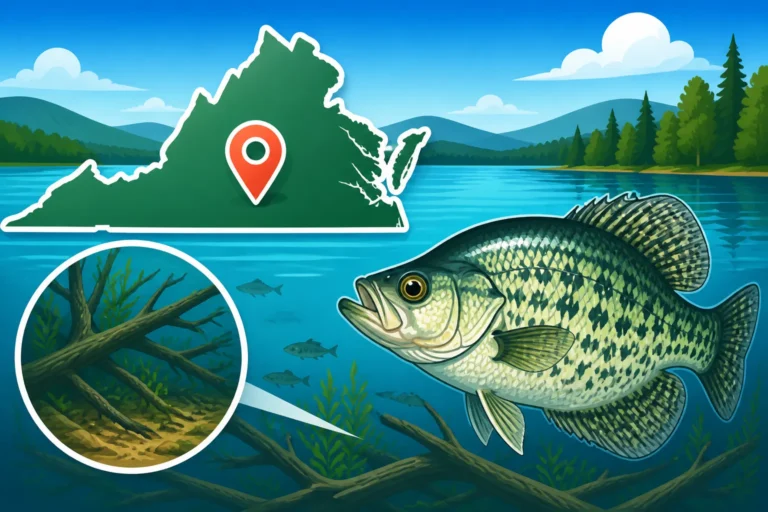
The black crappie ( Pomoxis nigromaculatus) is a beautiful fish, often admired for its distinctive appearance. Many anglers consider it a prize catch, not just for its fighting spirit but also for its delicate flavor. These fish are pretty common throughout Virginia, from larger reservoirs down to smaller ponds, and they provide excellent fishing opportunities year-round. They're particularly popular in some of Virginia's top fishing lakes.
Distinctive Markings and Coloration
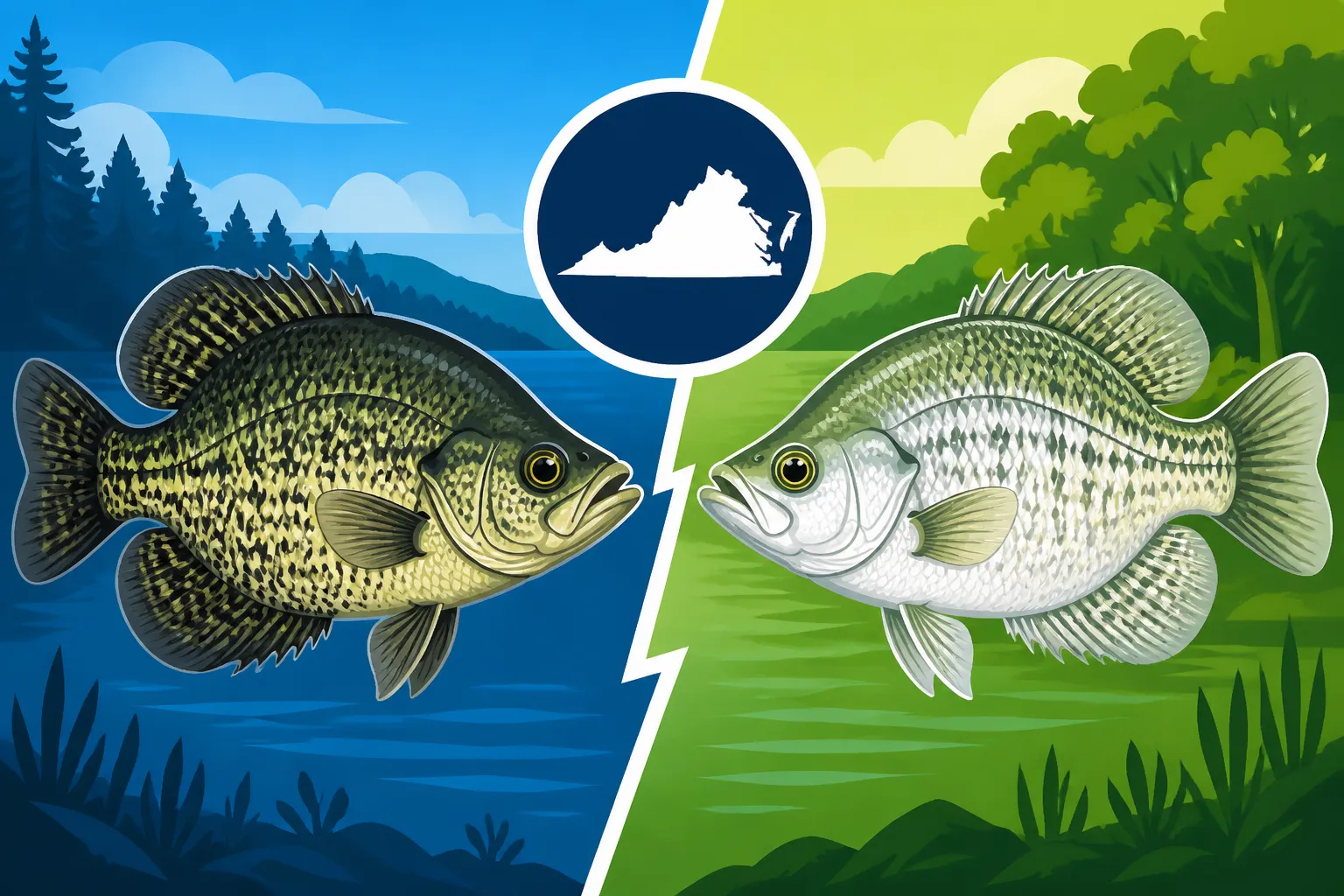
When you pull a black crappie from the water, the first thing you'll probably notice is its dark, mottled appearance. They have a more irregular, speckled pattern across their silvery-gold to olive-green bodies, which gives them a somewhat "peppered" look. Think of it like someone sprinkled black pepper unevenly over the fish. These spots don't typically form distinct vertical bars like their white crappie cousins. The overall color can vary depending on water clarity and diet; fish from dark, tannic waters might appear darker, while those from clearer lakes could be lighter. Regardless of the exact shade, that scattered, speckled pattern is a hallmark of the black crappie. This camouflage helps them blend into rocky structures, submerged timber, and weed beds.
Fin Details and Body Shape
Another key identifier for black crappie lies in their dorsal fin. Count the spines on that fin (the one on their back, closest to their head). Black crappie almost always have 7 or 8 dorsal fin spines. This is a very reliable characteristic for identification, often more so than color, which can vary. In terms of body shape, black crappie tend to be a bit more "tall" or "deep-bodied" compared to white crappie, giving them a more rounded, disk-like profile when viewed from the side. Their mouth is fairly large, extending back to at least the middle of their eye, sometimes even further. This body shape is often advantageous for navigating through thick cover and ambush feeding.
Typical Black Crappie Habitat in Virginia
Black crappie are generally habitat-dependent, preferring clearer, cooler water with abundant vegetation or submerged woody structures. Think about those fallen trees along the shore, brush piles, or dense lily pad fields. They love to lurk in these protected areas, waiting to ambush unsuspecting baitfish or insects. Lakes like Smith Mountain Lake and Lake Anna often hold healthy populations of black crappie, particularly in their clearer coves and along deeper structure. They're less tolerant of turbidity and siltation than white crappie, so if you're fishing in a very muddy river or a perpetually turbid lake, you might find fewer black crappie and more of their white-barred relatives. Learning How to Catch Crappie Around Brush Piles is often a great strategy for targeting black crappie.
Unmasking the White Crappie: The Vertical Barred Challenger
The white crappie ( Pomoxis annularis) is another beloved panfish across Virginia, offering a fantastic fight on light tackle and making for an excellent meal. They are often found in similar waters as black crappie but have some distinct preferences and physical traits that set them apart. Don't let the name "white" fool you completely; they're not always stark white, but their patterns are noticeably different.
Spotting the Stripes and Silvery Sheen
The most obvious distinguishing feature of the white crappie is its series of distinct, dark vertical bars running down its sides. While the exact number can vary, you'll typically see 5 to 7 well-defined bars, giving them a striped or banded appearance. These bars are usually more organized and less scattered than the spots on a black crappie. Their body color tends to be lighter, a silvery-white or pale green, making those dark bars stand out even more. Again, environmental factors can influence their exact hue, but those vertical stripes are usually unmistakable once you know what to look for. This pattern can sometimes make them blend into the dappled sunlight and shadows of open water or sparse cover.
Differentiating Dorsal Fin Spines
Just like with the black crappie, the dorsal fin spines are a crucial identifier for white crappie. White crappie consistently have 5 or 6 dorsal fin spines. This count is usually less than that of a black crappie, making it a reliable way to differentiate the two species, especially if you're still getting the hang of their body patterns. Feel those sharp little spines carefully! In terms of overall body shape, white crappie often appear a bit more elongated or "football-shaped" compared to the deeper-bodied black crappie. They still have that large mouth, but their profile might seem a touch less rounded.
Preferred White Crappie Hangouts in Virginia
White crappie are a bit more adaptable when it comes to habitat. While they appreciate structure, they are generally more tolerant of turbid (murky) water, siltation, and fluctuating water levels. You'll often find them thriving in larger rivers, impoundments with more current, and lakes with muddier bottoms. They tend to school in open water more frequently than black crappie, especially when chasing baitfish, and might associate with less dense cover like scattered stumps or drop-offs. The big reservoirs like Kerr Lake (Buggs Island Lake) or Lake Gaston, especially in their lower, wider sections, can be fantastic for white crappie. They are also prevalent in many of Virginia's tidal rivers. If you're wondering about Best Bait for Crappie Fishing in Virginia, remember that white crappie might be more receptive to baits presented in open water or around the edges of structure.
Putting It All Together: A Field Guide to Crappie Identification
It can be a bit overwhelming when you're out on the water, excited about your catch, trying to remember all these details. But with a little practice and knowing the key things to look for, you'll be identifying crappie like a pro in no time.
Key Visual Cues at a Glance
Let's simplify it. When you land a crappie, take a quick mental checklist:
- Body Pattern: Are the dark markings scattered, irregular, and speckled (black crappie), or do they form distinct vertical bars (white crappie)? This is usually the first and easiest visual cue.
- Dorsal Fin Spines: Count the sharp spines on the dorsal fin. If there are 7 or 8, it's likely a black crappie. If there are 5 or 6, it's almost certainly a white crappie. This is the most definitive external characteristic.
- Body Shape: Does the fish look a bit more rounded and deep-bodied (black crappie), or a little more elongated (white crappie)? This is a more subtle difference but can help confirm your initial assessment.
These three points, especially the fin spine count, will get you to the correct identification over 95% of the time. Don't worry if the "white" crappie isn't pure white; focus on the pattern and the spine count. A small, laminated fish identification card, easily found on Amazon, can be a great addition to your tackle box for quick reference!
Here's a quick comparison table to help you out in a pinch:
| Feature | Black Crappie ( Pomoxis nigromaculatus) | White Crappie ( Pomoxis annularis) |
|---|---|---|
| Body Markings | Irregular, scattered dark spots/speckles | 5-7 distinct dark vertical bars |
| Dorsal Fin Spines | 7 or 8 | 5 or 6 |
| Body Shape | Deeper, more rounded/disk-like | More elongated/football-shaped |
| Habitat Preference | Clearer water, dense vegetation/cover | More tolerant of turbidity, open water, sparser cover |
| Mouth | Upper jaw extends to or beyond pupil | Upper jaw extends to middle of eye |
Beyond the Spots: Gill Raker Count as a Definitive Test
For the truly dedicated angler or biologist, there's an even more definitive, though slightly more involved, method: counting the gill rakers. These are small, bony projections on the gill arches inside the fish's mouth, designed to filter food. Black crappie typically have 12-15 gill rakers on the lower part of their first gill arch, while white crappie have 6-9. This isn't something most recreational anglers will do on the water, as it requires a closer examination of the fish, but it's a scientific way to confirm identification if there's ever any doubt or an unusual hybrid. For day-to-day fishing, stick with the dorsal fin spines and body pattern, but it's cool to know there's a foolproof method for those super tricky cases!
Beyond Identification: Fishing Strategies for Each Crappie Species
Once you can tell these two apart, you can start to fine-tune your fishing strategies. This is where the real fun begins and where your knowledge truly pays off. Knowing the preferences of each species allows you to present your bait in the most appealing way in the most likely locations.
Tackling Black Crappie: Structure and Stealth
Black crappie are often found holding tight to cover, whether it's submerged brush, fallen trees, dock pilings, or dense weed beds. They prefer ambush points where they can hide and dart out to grab passing prey. This means your approach needs to be precise and often stealthy.
- Targeting Cover: Look for dense structure in clearer water. Work your baits slowly and deliberately into and around the cover. A silent approach with a kayak or trolling motor is often more effective than roaring up to a spot with a big outboard.
- Bait Presentation: Smaller jigs (1/32 to 1/16 ounce) tipped with soft plastic bodies or live minnows are excellent choices. Vertically jigging right into the heart of the cover, or slowly retrieving along the edges, can be deadly. Using a sensitive rod will help you detect those subtle "thumps" and light bites common with crappie, particularly the black crappie, which can be a bit more finicky. You can find some fantastic ultralight rod and reel combos on Amazon that are perfect for this delicate presentation.
- Depth: Black crappie can suspend at various depths, but they are often found where the cover meets deeper water, or right within the densest part of the cover. A good depth finder helps tremendously here.
Learning Crappie Jigging Techniques is paramount for catching black crappie, as they often require precise bait placement.
Pursuing White Crappie: Schooling and Open Water
White crappie, while still appreciating structure, are more inclined to roam and suspend in open water, especially when actively feeding on schools of baitfish. They are often found in larger schools than black crappie, making for exciting "hot spot" fishing when you find them.
- Finding Schools: Use your fish finder to locate schools of baitfish or suspended crappie. White crappie often relate to creek channels, humps, and submerged roadbeds, especially in more turbid conditions. They might not be as tightly bound to dense cover, often preferring the edges or tops of structures, or even just suspending over open flats.
- Trolling and Drifting: Because they school and roam more, trolling small crankbaits or multiple-jig rigs (like a spider rig) can be very effective for covering water and finding white crappie. Drifting with live minnows under a slip bobber in deeper channels is another popular and effective method. If you're looking for Crappie Tightlining Basics, white crappie might be a better target due to their schooling nature.
- Bait Selection: Similar to black crappie, small jigs and minnows work wonderfully. However, since white crappie might be more aggressive in open water schools, slightly larger baits or faster retrieves can sometimes entice a bite. Experiment with different colors and sizes of jigs (again, Amazon has a huge selection of crappie baits to choose from!) to see what they are hitting on any given day.
Understanding the Best Time of Year for Crappie Fishing in Virginia for each species, and where they tend to hold during different seasons, will give you an even greater advantage. Whether you're targeting black or white crappie, both offer incredible sport and are truly delicious table fare. If you're curious about table quality, you might enjoy our article Black Crappie vs White Crappie: Which Tastes Better?.
Final Thoughts on Crappie Identification
So, there you have it – a comprehensive look at how to tell your black crappie from your white crappie in the waters of Virginia. It’s not just an academic exercise; it’s a practical skill that will genuinely improve your fishing experiences. Armed with this knowledge, you can now confidently identify your catches, understand their preferences, and adjust your tactics to put more fish in the boat or on the bank. So grab your tackle, head out to your favorite Virginia lake or river, and enjoy the thrill of targeting these fantastic panfish with newfound confidence! Happy fishing, fellow anglers!
Disclaimer
This article is for general informational purposes only and does not constitute professional advice. Laws, prices and regulations vary by location and change over time. Consult a qualified professional for guidance on your specific situation.