How to Identify a Largemouth Bass in Virginia
It's happened to every angler out there: you pull in a beautiful bass, and for a split second, you're not entirely sure what you've got on the end of your line. Is it a largemouth, a smallmouth, or one of those tricky spotted bass? In Virginia, where we're blessed with several amazing bass fisheries, telling them apart can sometimes feel like a pop quiz. This guide is here to simplify that, helping you confidently identify that classic largemouth bass, so you know exactly what you've caught.
The Classic Largemouth Bass Profile
When we talk about bass fishing in Virginia, the largemouth often steals the show. It's the quintessential freshwater predator, known for its aggressive strikes and powerful fights. But beyond its reputation, it has some pretty clear physical traits that set it apart.
Overall Body Shape and Size
Imagine a green football with fins – that's often the first image that comes to mind with a largemouth. They tend to have a stocky, robust body, often appearing deeper through the middle compared to their sleeker smallmouth cousins. Their profile is generally more rounded and less elongated.
In Virginia, you'll find largemouth bass of all sizes. From eager little yearlings that are barely bigger than your hand to true lunkers that can push well over ten pounds in our trophy lakes. A typical keeper-sized largemouth might be anywhere from 12 to 20 inches, but don't let size alone be your only identification clue. Sometimes, a particularly chunky smallmouth or a well-fed spotted bass can fool you, especially if you're not used to seeing big ones from those species. The overall build, however, usually leans towards that substantial, powerful look for a largemouth. Their powerful tails are perfectly designed for explosive bursts of speed from cover, which contributes to that hefty, muscular feel when you reel them in.
Distinctive Coloration and Markings
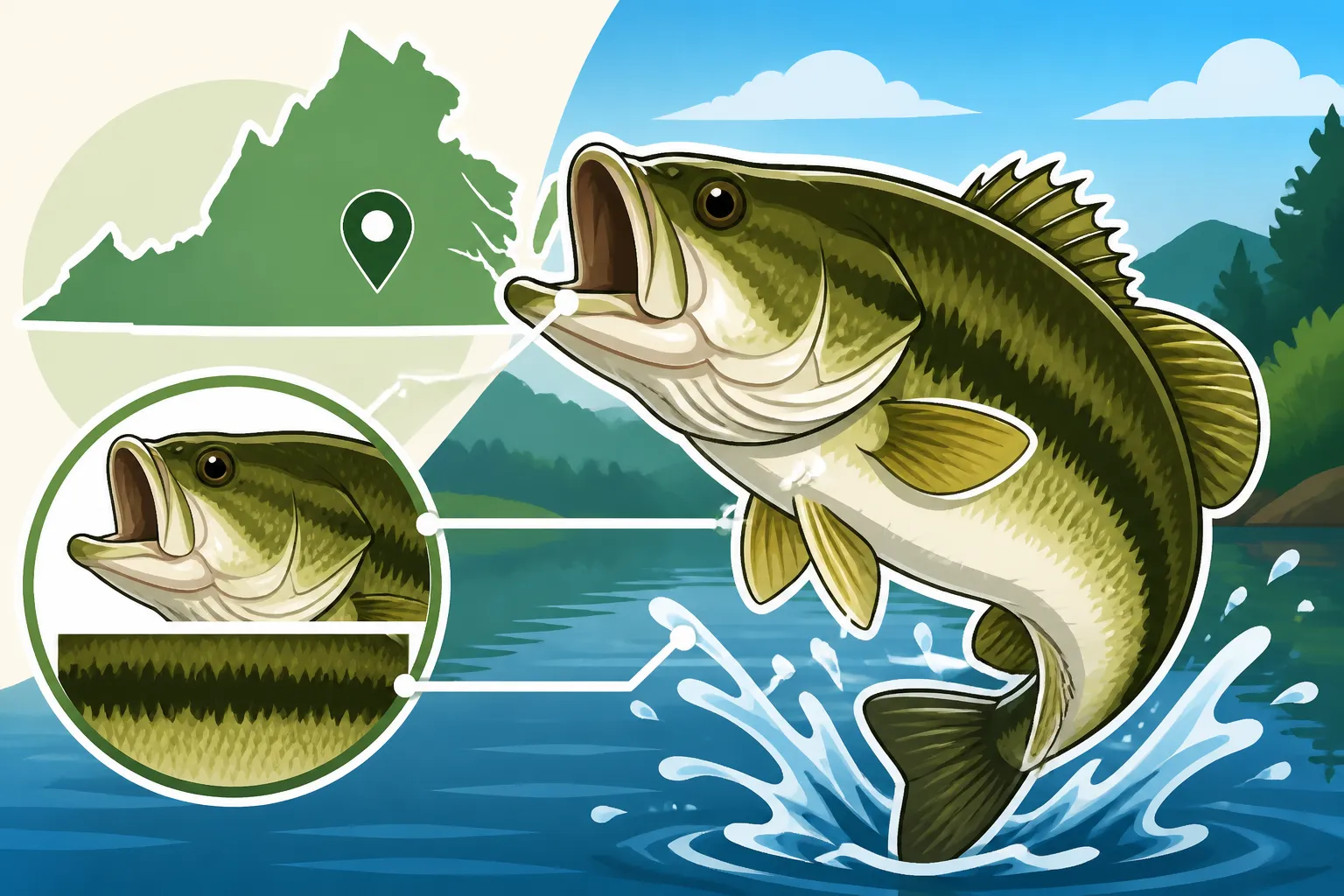
Largemouth bass are masters of camouflage, and their coloration can vary quite a bit depending on where they live. Generally, you'll find them sporting shades of dark green to olive green on their backs, fading into lighter green or even white on their bellies. The most characteristic marking is a prominent, dark, horizontal band or blotchy line that runs along the side of their body, from the gill plate right back to the tail. This lateral line can sometimes appear broken or as a series of distinct splotches rather than a solid stripe, especially on older fish or those from very clear water.
Compare this to, say, a smallmouth bass, which often has vertical bars or blotches and a more brownish or bronze hue. Spotted bass might have a lateral line too, but it often looks more like a series of distinct spots, and their belly scales usually have dark centers, giving them a "spotted" appearance. The largemouth's lateral line is typically the most obvious and defining pattern. For fish living in murky or stained waters, their colors might be darker and more muted, while those from crystal-clear lakes might exhibit brighter, more vibrant greens. Juvenile largemouths often have an even more pronounced and darker lateral band, sometimes with a bright orange or reddish hue in their fins, which fades as they mature.
Key Anatomical Features for Identification
While body shape and color give you a good first impression, the true diagnostic features of a largemouth bass are found in its mouth and fins. These are the details that separate them conclusively from other bass species.
The Mouth: A True Largemouth
This is arguably the most critical feature to check when trying to identify a largemouth bass. As its name suggests, the largemouth has a noticeably large mouth. To confirm, gently close the fish's mouth and observe where the corner of the jaw (the maxilla) extends in relation to its eye. For a largemouth bass, this jaw joint will extend beyond the back edge of the eye. It's a clear, unmistakable trait that immediately tells you what you're holding.
Contrast this with a smallmouth bass, where the jaw typically doesn't extend past the middle of the eye. A spotted bass will have a jaw that extends roughly to the middle or just slightly past the back edge of the eye, making it intermediate but still distinct from the full "largemouth" extension. This visual cue is the easiest and most reliable way to make an initial identification. Always handle fish gently when checking this, and wet your hands beforehand to protect their slime coat. It's a quick check that can be done right at the side of the boat or bank.
Dorsal Fin Separation
Another excellent anatomical clue is the dorsal fin, located on the fish's back. The dorsal fin of a largemouth bass is clearly divided into two distinct sections: a spiny front section and a soft-rayed rear section. There's a noticeable, deep notch or separation between these two parts, making it look almost like two separate fins. You can often slide your finger into this dip.
In smallmouth bass, these two dorsal fin sections are typically connected, forming one continuous fin with only a slight dip. Spotted bass also tend to have a more connected dorsal fin, similar to a smallmouth, though sometimes with a slightly deeper notch than a true smallmouth. This distinct separation on the largemouth is a consistent feature that helps confirm your catch, especially when you're comparing it side-by-side with other bass species. It's a structural difference that's easy to see and feel.
Tongue Patch and Scales
While less prominent than the mouth and dorsal fin, other features like the tongue and scales can offer additional verification, especially if you're still unsure. A key difference when it comes to the tongue is that largemouth bass typically do not have a distinct patch of small teeth on their tongue. If you gently open their mouth and feel their tongue, it will usually be smooth.
This is a crucial identifier because spotted bass (and Alabama bass, which are a type of spotted bass) do possess a small, rough patch of teeth on their tongue. So, if you're on the fence between a largemouth and a spotted bass, a quick check of the tongue can often settle the debate. As for scales, largemouth bass generally have large, rough scales. While not as easy to use for quick identification as other features, the overall pattern and size of the scales contribute to the largemouth's characteristic appearance. You might notice the scales around the cheek area are slightly smaller than those on the main body.
Habitat and Behavior Clues
Beyond their physical characteristics, understanding where largemouth bass prefer to live and how they behave can also help you identify them, sometimes even before you get them close enough to see their mouth.
Preferred Virginia Habitats
Largemouth bass are true structure-oriented fish, and they absolutely love cover. In Virginia, you'll find them holding tight to things like submerged logs, fallen trees, brush piles, boat docks, bridge pilings, and dense aquatic vegetation like lily pads and thick weed beds. They are ambush predators, meaning they'll lie in wait, perfectly camouflaged, ready to dart out and strike unsuspecting prey. You'll often find them in warmer, shallower water compared to smallmouth bass, thriving in nutrient-rich lakes, ponds, and slow-moving rivers.
Think about places like Smith Mountain Lake Fishing Guide or Lake Anna Fishing Guide, which are famous for their largemouth populations. These lakes are characterized by extensive shallow coves, standing timber, and abundant natural and man-made structures that provide ideal hiding and hunting grounds for largemouth. If you're consistently catching bass out of thick cover in warm water, chances are you're dealing with a largemouth. This preference for cover is why anglers often pitch and flip jigs or soft plastics into tight spots where other fish might not dare to go.
Feeding Habits and Lure Preferences
Largemouth bass are opportunistic and aggressive feeders, ready to strike at almost anything that looks like a meal. Their diet primarily consists of baitfish like shad and sunfish, as well as crayfish, frogs, insects, and even small rodents or ducklings that fall into the water. This broad diet means they respond well to a wide variety of lures designed to imitate these prey items.
Anglers targeting largemouth bass often use techniques that mimic these movements, such as casting crankbaits that dive and wobble, or slowly working soft plastic worms and creature baits along the bottom. Topwater lures, which create a commotion on the surface, are also incredibly effective, especially during low-light conditions. If you're stocking up on tackle, consider a versatile selection of crankbaits, jigs, plastic worms, and spinnerbaits. You can find many excellent options for these on Amazon, ready to entice that big largemouth. The fact that they'll readily hit a big, bulky lure is often a good indicator, as smaller-mouthed bass might struggle with larger presentations. Their feeding behavior, characterized by powerful strikes near cover, strongly points to their identity even before you bring them to the boat.
Distinguishing Largemouth from Other Virginia Bass Species
Knowing the unique traits of a largemouth is one thing, but being able to quickly differentiate it from its cousins, the smallmouth and spotted bass, is where your identification skills truly shine. These subtle differences become second nature over time.
Largemouth vs. Smallmouth Bass
The most common mix-up in Virginia is between largemouth and smallmouth bass, especially for newer anglers. But once you know what to look for, the differences are quite stark.
Key Differences:
- Mouth Size: This is the easiest. On a largemouth, the jaw extends beyond the eye. On a smallmouth, it stops roughly below the middle of the eye.
- Dorsal Fin: Largemouths have a deep, distinct separation between the spiny and soft-rayed dorsal fins. Smallmouths have a more continuous dorsal fin, with only a slight notch.
- Coloration: Largemouths are typically green with a prominent, dark horizontal lateral line (sometimes blotchy). Smallmouths often have a brownish, bronze, or golden hue with vertical bars or tiger stripes.
- Body Shape: Largemouths are generally deeper-bodied and more stout. Smallmouths are typically sleeker and more streamlined.
- Habitat: Largemouths prefer warmer, shallower, weedy, and structured waters. Smallmouths thrive in cooler, clearer, rocky rivers and lakes with current (think Shenandoah River Fly Fishing for Trout and Smallmouth Bass in Virginia).
Imagine catching a fish in a fast-flowing, rocky river like the upper James; it's more likely to be a smallmouth. If you're pulling a bass from heavy lily pads in a quiet cove, it's almost certainly a largemouth. How to Identify a Smallmouth Bass in Virginia provides even more detailed comparisons to solidify your knowledge.
Largemouth vs. Spotted Bass (and Alabama Bass)
Spotted bass, and the closely related Alabama bass, are a bit trickier because they share some characteristics with both largemouth and smallmouth bass. They are often found in similar lake environments as largemouth, such as at Claytor Lake. Knowing how to distinguish them is particularly important for anglers in specific regions of Virginia where these species are present. For instance, Alabama Bass in Virginia: What Anglers Need to Know highlights that these newer species have different management needs.
Key Differences:
- Mouth Size: Spotted bass have a mouth that extends to the middle of the eye or slightly beyond, but not as far back as a largemouth.
- Tongue Patch: This is the most definitive test. Spotted bass will have a distinct patch of teeth on their tongue. Largemouth bass do not. Run your finger gently across the tongue – if it's rough, it's likely a spotted bass.
- Lateral Line & Belly: Spotted bass have a dark lateral line that is often a series of prominent spots. Crucially, the scales below the lateral line on a spotted bass often have distinct dark spots or pigmentation, giving the fish a "spotted" belly. Largemouths generally have a clean, white belly.
- Dorsal Fin: Similar to a smallmouth, the dorsal fins of a spotted bass are usually more connected than a largemouth, with less of a deep notch.
If you're fishing waters like Claytor Lake, where Alabama bass are present, these details become even more vital, as Alabama bass are very similar to spotted bass and can be nearly impossible to distinguish without very close inspection. Consulting resources like Spotted Bass vs Largemouth Bass: How Virginia Anglers Tell Them Apart can be incredibly helpful when you're in an area known for multiple bass species.
Why Accurate Identification Matters
Beyond the simple satisfaction of knowing what you've caught, accurate identification of bass species in Virginia carries practical and ethical implications for every responsible angler.
Adhering to Virginia Regulations
One of the most important reasons to accurately identify your catch is to ensure you're complying with Virginia's fishing regulations. Different bass species, and sometimes even different bodies of water, can have varying size and creel limits. For example, Statewide Bass Fishing Limits in Virginia details general regulations, but specific lakes or rivers might have Special Slot Limits on Certain Virginia Waters for particular bass species.
Imagine you're fishing a lake known for both largemouth and spotted bass. If you accidentally keep a spotted bass thinking it's a largemouth, and that spotted bass is outside its legal slot limit, you could face penalties. Virginia game wardens are highly knowledgeable, and they expect anglers to know the rules for the fish they're targeting. Misidentifying your catch isn't usually an excuse. By knowing exactly what you've caught, you're doing your part to respect the fish, the fishery, and the laws designed to conserve these amazing resources for future generations. Don't risk a fine or losing your catch; take the time to learn the differences. The Virginia Fishing Regulations Explained is your go-to resource for staying informed.
Enhancing Your Angling Skills
Accurate identification isn't just about following rules; it's also about becoming a more skilled and successful angler. When you can confidently identify a largemouth bass, you begin to build a mental map of where that species lives, what it eats, and how it behaves. This knowledge empowers you to make smarter decisions on the water.
Knowing you're targeting largemouths in, say, Largemouth Bass Fishing in Virginia's Chesapeake Bay Tributaries means you'll likely focus on heavy cover, use lures that mimic a largemouth's preferred forage, and adjust your techniques accordingly. If you mistakenly thought you were catching smallmouths, you might be fishing entirely different areas with different lures, leading to less success. Understanding your target species helps you choose the Best Bait for Largemouth Bass in Virginia, select the right rod and reel setup, and apply the most effective presentation. It transforms you from a casual caster to a strategic angler, making every trip more productive and enjoyable. It also deepens your appreciation for the unique ecological niches each bass species occupies.
| Feature | Largemouth Bass | Smallmouth Bass | Spotted Bass |
|---|---|---|---|
| Jaw Extension | Extends beyond the back edge of the eye | Extends to roughly the middle of the eye | Extends to the middle or slightly beyond the eye |
| Dorsal Fin | Deep, distinct separation (looks like two fins) | Slightly notched, more continuous | Moderately notched, more continuous than largemouth |
| Lateral Line | Prominent, dark horizontal band or blotchy line | Vertical bars or "tiger stripes" | Often a series of distinct spots |
| Belly Scales | Generally clean, white | Clean, white or light colored | Dark spots or pigmentation on scales below lateral line |
| Tongue Patch | Absent (smooth tongue) | Absent (smooth tongue) | Present (rough patch of teeth on tongue) |
| Overall Color | Green to olive green | Brown, bronze, or golden | Greenish-brown with darker spots |
| Typical Habitat | Warm, shallow, weedy, structured lakes and slow rivers | Cool, clear, rocky rivers and deep clear lakes | Often similar to largemouth, lakes and slow rivers |
Disclaimer
This article is for general informational purposes only and does not constitute professional advice. Laws, prices and regulations vary by location and change over time. Consult a qualified professional for guidance on your specific situation.