Virginia Bass Identification: Largemouth, Smallmouth, Spotted, and Alabama Compared
Ever felt that little thrill of a strong bite, reeled in a beautiful bass, and then scratched your head wondering exactly which kind of bass you just landed? You’re definitely not alone! Virginia's waters, especially those sparkling lakes and winding rivers, are home to a few different types of bass, and sometimes telling them apart can feel like a real puzzle. This guide is here to untangle that confusion, walking you through the distinct features of largemouth, smallmouth, spotted, and even the newer Alabama bass, so you can confidently identify your catch and understand why it matters.
The Challenge of Bass Identification in Virginia Waters
Virginia is a fantastic state for bass fishing, offering diverse habitats that appeal to several species. From the tidal rivers of the east to the mountain lakes and streams in the west, anglers encounter a variety of black bass. While many might recognize the classic largemouth, the nuances between its cousins—the smallmouth, spotted, and now, even the Alabama bass—can be subtle and easily overlooked by the untrained eye. This isn't just about trivia; accurate identification plays a crucial role in conservation and adhering to regulations.
Why Accurate Identification Matters
Beyond the satisfaction of knowing your fish, accurate bass identification is actually really important for a few key reasons. First, fishing regulations, especially length and creel limits, can vary by species and even by specific body of water. Imagine releasing a fish that you thought was a largemouth, only to find out it was a smallmouth that was perfectly legal to keep, or vice-versa! Not knowing could lead to accidental violations, which nobody wants. You can always check the latest rules by consulting the Virginia Fishing Regulations Explained guide.
Secondly, from a conservation standpoint, distinguishing between native and non-native species helps wildlife biologists manage fisheries effectively. For instance, the presence of Alabama bass, which isn't native to Virginia, can have significant ecological impacts on existing bass populations. Knowing what's in our waters allows for better monitoring and management strategies to protect the balance of our beloved fishing spots.
The "Look-Alike" Bass Problem
The real kicker is that these bass species, particularly the largemouth, spotted, and Alabama bass, can look remarkably similar. They all belong to the Micropterus genus, often called "black bass" for their generally darker, olive-green to brown coloration. Their body shapes are broadly similar, and even their lateral lines (the dark stripe running horizontally along their sides) can sometimes trick you. This visual similarity is precisely why so many anglers, even seasoned ones, find themselves double-guessing their catch.
Environmental factors like water clarity, diet, and even the fish's mood can alter its coloration, making a "dark" largemouth look like a "spotty" spotted bass. Sometimes, anglers report catching what they believe is a new species, only for it to be a variation of one they already know. It takes a keen eye and a bit of knowledge to pick out the distinct features that truly set each species apart, and that's what we're going to dive into next.
Deconstructing the Big Three: Largemouth, Smallmouth, and Spotted Bass
Let's start with the bass species that most anglers are familiar with, or at least have a good chance of encountering across various Virginia waters. These three form the backbone of our state's incredible bass fisheries, each with its unique characteristics and preferred habitats.
Largemouth Bass: The Classic Southern Angler's Prize
Ah, the largemouth bass! This is probably the image that pops into most people's heads when they think of bass fishing. Largemouths are the quintessential warm-water bass, thriving in slow-moving rivers, ponds, and especially large lakes with plenty of submerged vegetation, fallen timber, and docks to hide under. They are ambush predators, often lurking in cover, waiting to pounce on unsuspecting prey. You'll find fantastic largemouth fishing in places like Smith Mountain Lake and Lake Anna. For a deep dive into identifying this particular species, check out How to Identify a Largemouth Bass in Virginia.
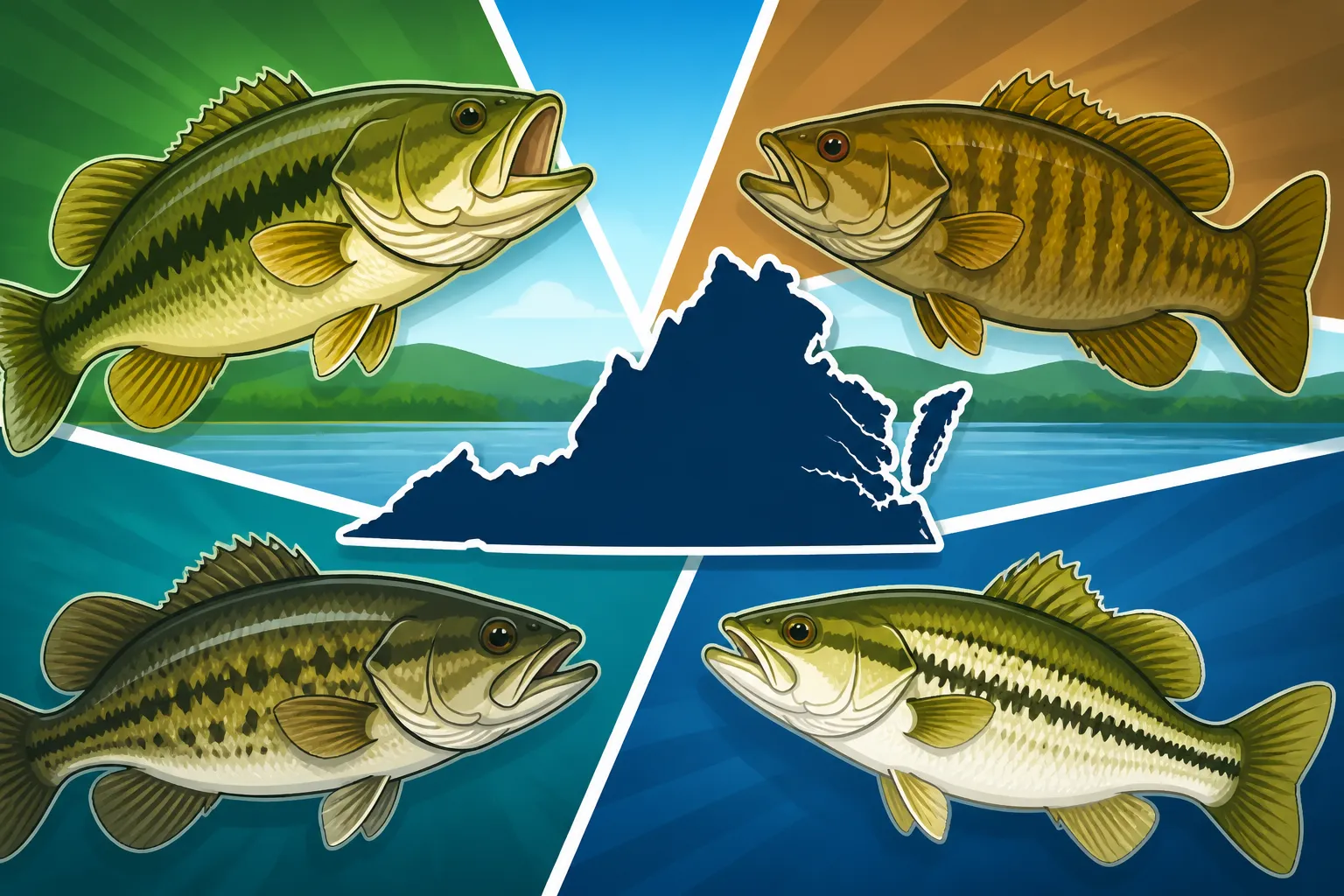
Visually, the largemouth is usually a dark green to olive color on its back, fading to lighter sides and a white belly. A distinct, often broken, dark lateral line runs horizontally along its side, sometimes looking like a series of connected blotches rather than a solid stripe. But the most defining feature, and the one that gives it its name, is its mouth. When its mouth is closed, the jaw extends well past the back of its eye. They also tend to have a deeply notched dorsal fin, appearing almost separated into two distinct fins.
Smallmouth Bass: River Fighters with a Golden Hue
If you love clear, cool, flowing water, then you're probably chasing smallmouth bass. These powerful fighters are often found in Virginia's rivers and larger, cooler lakes, preferring rocky bottoms, gravel, and areas with current. Think of the mighty James River or the scenic Shenandoah River; these are prime smallmouth territories. Unlike their largemouth cousins, smallmouths aren't usually found lurking in dense weeds. Instead, they patrol open, rocky areas, often near submerged boulders or ledges. If you're keen to learn more about these bronze beauties, we've got a detailed guide on How to Identify a Smallmouth Bass in Virginia.
Smallmouth bass typically have a more bronze or brownish coloration, sometimes with vertical bars or mottling on their sides, rather than a distinct horizontal line. Their eyes often appear reddish, and their body is generally more streamlined and torpedo-shaped compared to the largemouth's chunkier build. The key identifier for a smallmouth is, again, its mouth: when closed, the jaw does not extend past the back of its eye. Its dorsal fin is also much less deeply notched than a largemouth's, appearing more as a single, continuous fin.
Spotted Bass: The Often Confused Cousin
Now, here's where things get a little tricky for many anglers. Spotted bass often get mistaken for largemouth bass, and it's easy to see why! They share similar greenish coloration and a lateral line that can appear blotchy. However, spotted bass are generally smaller than largemouths, rarely reaching the same trophy sizes. They prefer a habitat that's a bit of a mix between largemouth and smallmouth preferences – often found in larger streams and smaller to medium-sized rivers, and reservoirs with rocky or gravel bottoms, but also tolerant of some vegetation. Lakes like Claytor Lake can have a good population of spotted bass.
To tell a spotted bass apart, the first thing to look at is the mouth. Like the smallmouth, its jaw typically doesn't extend past the back of its eye when closed. This is the biggest differentiator from a largemouth. But unlike the smallmouth, a spotted bass will have distinct rows of dark spots below its lateral line, often arranged in neat, horizontal rows on its belly. Another crucial feature, and one you might need to feel, is a patch of small, rough teeth on its tongue. This "tooth patch" is present on spotted bass and Alabama bass, but absent on largemouth and smallmouth bass. For a more direct comparison between these two, read our article Spotted Bass vs Largemouth Bass: How Virginia Anglers Tell Them Apart.
Understanding the Alabama Bass: A Newer Player in Virginia's Waters
While the first three bass species are generally well-known, the Alabama bass is a relative newcomer to Virginia's fishing scene, and its presence can cause both excitement and concern among anglers and biologists. It's an invasive species in many areas outside its native range (which is primarily rivers in Alabama, Georgia, and Tennessee), and it has made its way into certain Virginia waters, notably Claytor Lake.
Identifying Alabama Bass in Claytor Lake
The Alabama bass is probably the most challenging to distinguish, as it looks remarkably similar to the spotted bass. In fact, many anglers initially misidentify them as spotted bass. They share the same general greenish color, a lateral line that can be blotchy, and those characteristic rows of spots below the lateral line on the belly. Like the spotted bass, the Alabama bass also has a jaw that doesn't extend past the back of the eye and possesses that tell-tale tooth patch on its tongue. So, if they look so similar, how do you tell them apart? Check out Alabama Bass Identification for Claytor Lake Anglers for more specifics.
The key differences are subtle but present. Alabama bass tend to have a more elongated body shape than spotted bass, and their scales are often described as appearing smaller. A more reliable field mark, though still subtle, is the area of scales on the cheek. On an Alabama bass, the scales on the cheek extend further forward towards the eye than on a spotted bass, leaving less bare skin. Another subtle clue is the connection between the two sections of the dorsal fin; in Alabama bass, the membrane connecting them is often lower, making the two parts appear more distinct than on a spotted bass. Because these differences are so minute, it's really easy to get it wrong. Many times, definitive identification even requires genetic testing. If you're fishing in Claytor Lake, it's particularly important to be aware of Alabama Bass in Virginia: What Anglers Need to Know.
The Impact of Alabama Bass on Native Fisheries
The introduction of Alabama bass into waters where they aren't native is a significant concern for wildlife managers. The biggest problem is hybridization and competition. Alabama bass are known to interbreed with native smallmouth and spotted bass, creating hybrid offspring that can dilute the genetic purity of the native populations. These hybrids can sometimes outcompete native bass for food and habitat, potentially leading to a decline in the native species over time.
For example, in Claytor Lake, the Alabama bass population has grown, and there's evidence of hybridization with the native smallmouth bass. This can alter the characteristics of the fishery, impacting growth rates, maximum sizes, and overall population health of the traditional bass species. Understanding this impact is why proper identification and reporting of Alabama bass (especially in new waters) is so critical. If you're concerned about distinguishing between these two, our article Alabama Bass vs Spotted Bass: How to Tell Them Apart offers more insight.
Key Distinguishing Features: A Side-by-Side Comparison
Let's get down to the nitty-gritty and lay out the primary features that will help you tell these bass apart. Remember, it's often a combination of factors, not just one, that provides the most reliable identification. When you've got a fish in hand, quickly scan for these key clues.
Here's a handy table summarizing the main differences:
| Feature | Largemouth Bass | Smallmouth Bass | Spotted Bass | Alabama Bass |
|---|---|---|---|---|
| Upper Jaw (closed) | Extends past back of eye | Does NOT extend past back of eye | Does NOT extend past back of eye | Does NOT extend past back of eye |
| Dorsal Fin Notch | Deeply notched, almost two separate fins | Shallowly notched, appears as one continuous fin | Moderately notched, more continuous than LM | Moderately notched, slightly more distinct than SP |
| Body Color/Pattern | Dark green, distinct horizontal lateral line (often broken) | Bronze/brown, vertical bars/mottling, no strong lateral line | Green/olive, horizontal rows of spots below lateral line | Green/olive, horizontal rows of spots below lateral line, very similar to spotted |
| Tongue Tooth Patch | Absent | Absent | Present | Present |
| Cheek Scales | Generally larger, less distinct pattern | Fine scales, uniform | Scales don't extend far forward towards eye | Scales extend further forward towards eye |
| Overall Shape | Chunkier, taller body | More streamlined, torpedo-shaped | Intermediate, similar to smallmouth but spots | More elongated, slightly more slender than spotted |
Mouth Size and Jawline Clues
This is often your very first and easiest check. Pick up the fish, gently close its mouth, and look at where the back of its upper jaw (maxillary) ends in relation to its eye.
- Largemouth Bass: The mouth is noticeably large. The jaw will extend past the back edge of the eye. Think of it as a "big-mouthed" fish, true to its name.
- Smallmouth Bass, Spotted Bass, Alabama Bass: For all three of these, the jaw will not extend past the back edge of the eye. It will end roughly underneath the middle or front half of the eye. If it's a smallmouth, spotted, or Alabama bass, this immediately rules out a largemouth.
This single feature is incredibly reliable for separating largemouths from the other three.
Dorsal Fin Separation and Spotting Patterns
Next, look at the fin on the fish's back, called the dorsal fin.
- Largemouth Bass: This fish has a very pronounced, deep notch in its dorsal fin, making it look almost like two separate fins joined at the base.
- Smallmouth Bass: The smallmouth's dorsal fin has a much shallower notch, making it appear more as one continuous fin.
- Spotted Bass and Alabama Bass: These two are intermediate. They have a more continuous fin than a largemouth, but often a slightly more noticeable notch than a smallmouth. This can be tricky, so it's not the primary identifier between spotted and Alabama.
Now, for patterns:
- Largemouth Bass: Typically has a dark, often broken, horizontal band (lateral line) running down its side. The belly is usually clean and white.
- Smallmouth Bass: Often has faint vertical bars or a mottled pattern on its sides, especially when stressed or in clear water. No strong horizontal lateral line of spots.
- Spotted Bass and Alabama Bass: This is their signature! Look below the lateral line on their belly, towards the tail. You'll see distinct, often neat, rows of dark spots. This is a very reliable sign for these two, distinguishing them from both largemouth and smallmouth.
Scale Patterns and Cheek Patches
These are more subtle but can be helpful for those difficult distinctions, especially between spotted and Alabama bass.
- Tongue Tooth Patch: This is a major clue for spotted and Alabama bass. Gently open the fish's mouth and run your finger across its tongue. If you feel a small, rough patch of teeth, it's either a spotted or an Alabama bass. Largemouths and smallmouths do not have this. This is a great way to differentiate them from largemouths once you've checked the jawline.
- Cheek Scales: This is primarily useful for differentiating spotted from Alabama bass. On an Alabama bass, the scales on the cheek (the area behind and below the eye) tend to extend further forward, closer to the eye. On a spotted bass, there's usually a slightly larger area of unscaled skin directly behind and under the eye. This requires a very close look!
- Overall Body Shape: Largemouths are often described as stocky or chunky. Smallmouths are generally more sleek and muscular, like a torpedo. Spotted bass often fall somewhere in between, while Alabama bass can sometimes appear slightly more elongated than spotted bass.
Practical Tips for Anglers on the Water
Identifying bass in the field requires a keen eye and sometimes a quick hand. Here are some actionable tips to help you make those distinctions while you’re out enjoying Virginia’s fantastic fishing opportunities.
What to Look for Immediately Upon Catch
When you land a bass, don't just admire it and toss it back (or in the livewell) without a second thought. Take a moment to examine it.
- Check the Jaw: This is your fastest and most reliable initial ID. Hold the fish gently, close its mouth, and see if the jaw extends past the eye. If it does, it's a largemouth. If not, it's one of the others.
- Look for Spots on the Belly: If the jaw doesn't extend past the eye, quickly look for those horizontal rows of spots on the lower sides/belly. If they're there, it's likely a spotted or Alabama bass. If not, and you see vertical bars or mottling, it's probably a smallmouth.
- Feel the Tongue: If you have spots on the belly, gently feel the tongue for that rough patch of teeth. This confirms it's a spotted or Alabama bass.
- Dorsal Fin: Take a quick glance at the dorsal fin notch as a secondary confirmation. Is it very deep (largemouth) or shallow/continuous (smallmouth)? Or somewhere in between (spotted/Alabama)?
Remember, handling fish quickly and gently is key for their health, especially if you plan to release them. A good pair of fish grippers can help you secure the fish for a quick inspection. You can find excellent options on Amazon that make handling easier and safer for both you and the fish.
Using Photography for Later Confirmation
Sometimes, especially if you're in a rush or unsure, a good photograph can be your best friend for later identification.
- Clear Shots: Try to get clear photos from multiple angles. A side profile shot that clearly shows the jawline relative to the eye is crucial. Also, try to get a shot of the belly area for spotting patterns.
- Tongue Shot: If you suspect a spotted or Alabama bass, try to get a quick, clear photo of the open mouth showing the tongue.
- Full Body: A shot of the entire fish can help with overall body shape and dorsal fin assessment.
- Use a Scale/Ruler: If you're measuring the fish, ensure the photo clearly shows the length against the ruler. Not only is this great for bragging rights, but it also helps with regulations. Many anglers carry a small, waterproof field guide, which can be easily slipped into a fishing vest pocket or tackle box. A good quality fishing ruler or scale from Amazon can also be a helpful tool for documenting your catch properly.
Later, you can compare your photos against reliable identification guides. There are also many online forums and social media groups dedicated to Virginia fishing where experienced anglers can help confirm your identification.
Resources for Further Identification and Reporting
If you're still scratching your head after reviewing your photos, or if you suspect you've caught an Alabama bass in a new body of water, there are resources available:
- Virginia Department of Wildlife Resources (DWR): Their website is a treasure trove of information, including detailed fish identification guides and current regulations. If you suspect you've caught an Alabama bass, especially in a new area, reporting it to the DWR is extremely important for their monitoring efforts. You can often find contact information on their site.
- Field Guides: Invest in a good waterproof fish identification guide for the mid-Atlantic region. Keep it in your tackle box or on your boat for quick reference. These are often packed with illustrations and details that can help immensely. You can find comprehensive guides on Amazon.
- Local Bait and Tackle Shops: The folks who work at your local bait and tackle shop are often incredibly knowledgeable about the fish in your area. Don't hesitate to bring in a photo or ask them questions. They're usually happy to share their expertise.
- Online Fishing Communities: Join Virginia fishing groups on social media platforms. Post your photos and ask for help. Just be prepared for a variety of opinions; always cross-reference with official DWR resources.
Knowing your bass isn't just about showing off; it's about being a responsible angler and contributing to the health of Virginia's amazing fisheries. So next time you feel that tug on your line, take a moment, examine your catch, and truly appreciate the diversity of bass that call our waters home.
Disclaimer
This article is for general informational purposes only and does not constitute professional advice. Laws, prices and regulations vary by location and change over time. Consult a qualified professional for guidance on your specific situation.