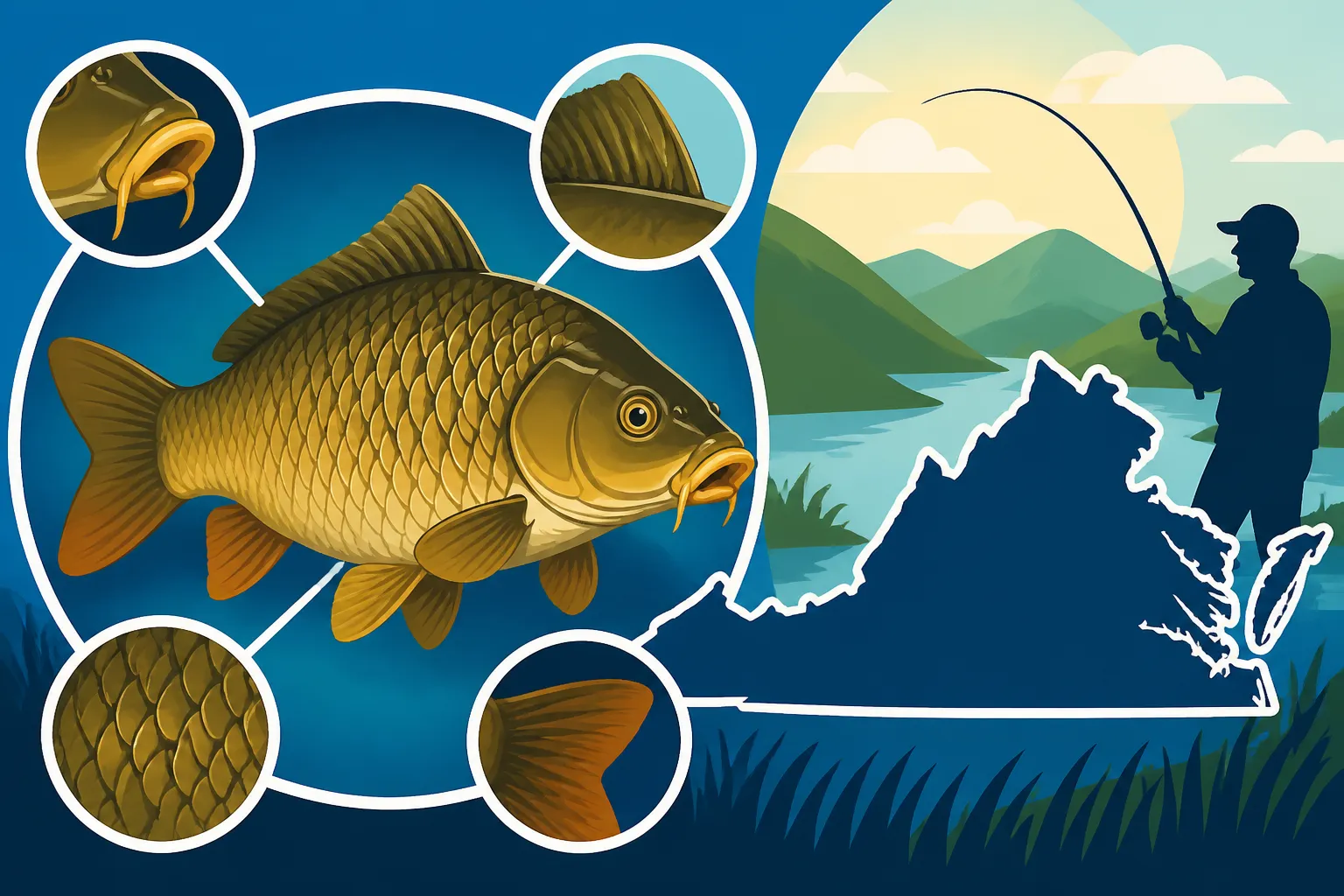
How to Identify a Carp
We've all been there: you're out on a beautiful Virginia lake or river, enjoying the peace and quiet, when suddenly your line goes taut, and you're fighting something big, strong, and unmistakable once you see it. But what exactly is it? Sometimes, with the thrashing and the murky water, it can be tough to tell. Often, it's a carp, and knowing which kind can really deepen your appreciation for Virginia's diverse aquatic life. This guide is here to help you confidently identify the various carp species you might encounter in the Commonwealth's waters.
The Common Carp: Virginia's Ubiquitous Bottom-Feeder
Let's start with the big one, literally and figuratively: the common carp. These fish are true survivors, found in almost every major river system and lake across Virginia. They're often underestimated, sometimes even dismissed, but they're powerful, intelligent, and a blast to catch once you learn their ways. The frustration often comes from not knowing exactly what you've hooked until it's right in front of you.
Physical Characteristics and Distinguishing Features
The common carp (scientific name Cyprinus carpio) is quite distinct once you know what to look for. They typically have a robust, somewhat torpedo-shaped body that can be deep-bodied, especially in older, larger specimens. Their coloration usually ranges from a brassy, golden olive on their backs and sides to a yellowish-white belly. This can vary quite a bit depending on the clarity of the water and the substrate they live over; fish from muddy, tannin-stained rivers might appear darker, almost brownish-gold, while those from clearer lakes can be brighter, almost coppery.
Perhaps their most defining characteristic is their large, distinct scales. These aren't tiny, smooth scales; they're prominent, often edged in a darker color, and give the fish a beautiful, almost armored appearance. Run your hand over a common carp, and you'll immediately notice the texture. Another tell-tale sign is their mouth. It's protrusible, meaning it can extend forward, like a vacuum cleaner nozzle, to suck up food from the bottom. Look closely, and you'll see two pairs of barbels, which are whisker-like sensory organs, dangling from the corners of their mouth and upper lip. These are crucial for foraging in murky water and are a dead giveaway for common carp.
Their dorsal fin is also quite distinctive: it's long and continuous, starting quite far forward on their back and extending almost to the tail. The leading ray of this dorsal fin, as well as the anal fin, is often serrated and quite stout, feeling almost like a small saw. This unique fin structure, combined with those big scales and barbels, really sets them apart from other bottom-feeders you might encounter, such as various species of suckers, which lack barbels and have smaller scales.
Key Visual Cues for Quick Identification
When you've got a fish on the line and it's thrashing at the surface, you need some quick visual cues to make that identification. For a common carp, the first things that often jump out are those large, reflective scales that catch the light, giving off a "golden flash" as the fish rolls. If you see that, you're almost certainly looking at a common carp or one of its close relatives.
Next, try to get a glimpse of its mouth area. Even if the fish is still in the water, those barbels are often visible, especially the longer pair. No other large, freshwater fish in Virginia, apart from some catfish (which have a very different body shape and lack large scales entirely), possesses such prominent barbels. The overall profile of the fish, a deep-bodied and somewhat humped back, is also a strong indicator.
Finally, observe its behavior. Common carp are notorious for stirring up the bottom as they feed, creating clouds of mud or even distinct chains of bubbles as they root around. If you're fishing a quiet cove and see these signs, especially in warmer, shallower water, there's a good chance a school of common carp is nearby. It's a fascinating display of their unique foraging strategy. You can learn more about where these fish thrive by checking out Carp Fishing in Virginia Lakes and Rivers.
Mirror and Leather Carp: Variations of the Common Carp
While the common carp is the most prevalent, you might also stumble upon a few interesting variations in Virginia's waters: the mirror carp and the leather carp. These aren't separate species, but rather genetic mutations of the common carp, selectively bred over centuries, particularly in Europe, for aquaculture. They've found their way into North American waters and can offer a truly unique catch.
Mirror Carp: The Disappearing Scales
Mirror carp are probably the most commonly encountered variant of the common carp. Their defining characteristic is right in their name: their scales, or lack thereof. Instead of the uniform, complete covering of large scales found on a common carp, mirror carp have irregular, often very large, plate-like scales that are sparsely distributed over their body. It's like someone picked out random scales and left big patches of smooth skin in between.
You might see a mirror carp with just a few rows of these giant scales running along its lateral line and dorsal ridge, or perhaps a smattering of scales here and there. Some even have almost no scales at all, resembling leather carp, which we'll get to in a moment. These large, often shiny scales are much bigger than those on a common carp, giving them a distinctive, almost prehistoric appearance. Aside from this unusual scale pattern, their body shape, mouth, barbels, and fin structure are essentially identical to the common carp. If you see a fish with the general carp profile but with oddly placed, super-sized scales, you've likely caught a mirror carp.
Leather Carp: The Smooth-Skinned Enigma
Even more striking than the mirror carp is the leather carp. This genetic variation takes the "lack of scales" to the extreme. Leather carp are almost entirely devoid of scales, giving them a smooth, often thick, and somewhat rubbery or leathery skin. It's a truly unusual sight if you're expecting the heavily scaled common carp.
Identifying a leather carp primarily relies on all the other characteristics of a common carp except the scales. Look for the distinct two pairs of barbels around its protrusible mouth. Observe its long dorsal fin, which will still have that stout, serrated leading ray. The overall deep, robust body shape will also be consistent. Without the scales, they can sometimes be momentarily confusing, but those barbels are the unequivocal giveaway that you're dealing with a carp. They’re a real treat for an angler, showcasing the fascinating genetic diversity within the species.
Grass Carp: The Herbivorous Imposter
Beyond the common carp and its variants, there's another carp species you might encounter in Virginia, one that looks quite different and has a completely distinct diet: the grass carp (Ctenopharyngodon idella). These fish were intentionally introduced to control aquatic vegetation, and while they serve a purpose, it's vital for anglers to be able to identify them accurately due to specific regulations that might apply, especially to their triploid (sterile) forms.
Differentiating Grass Carp from Common Carp
The key to distinguishing a grass carp from a common carp lies in a few critical differences. First, look at the body shape: grass carp are much more elongated and cylindrical, almost resembling a giant minnow or a large trout. They lack the deep-bodied, humped appearance often seen in common carp. They’re built for speed and cruising through dense vegetation, not rooting around in the mud.
Second, their scales are smaller and tighter than those of a common carp, giving them a smoother overall appearance, though they are fully scaled. The color is typically a silver-gray to greenish-gold on the back, fading to white on the belly. While they can grow to impressive sizes, their overall build is sleeker.
The most crucial difference, however, is their mouth and the absence of barbels. A grass carp's mouth is terminal, meaning it's located directly at the very front of its head, not tucked underneath like a common carp's. And here's the clincher: grass carp do not have barbels. This is the single most reliable feature to use when distinguishing them from common, mirror, or leather carp. If it's a carp-shaped fish with no whiskers, it's a grass carp. For a broader understanding of fishing regulations, check out Virginia Fishing Regulations Explained.
The Importance of Accurate Grass Carp Identification
Accurate identification of grass carp isn't just a matter of curiosity; it can be important for compliance with fishing regulations. Many of the grass carp stocked in Virginia are sterile "triploid" grass carp, used to control invasive aquatic plants without the risk of overpopulation. There might be specific rules regarding their possession or release, depending on the body of water and whether you catch a diploid (fertile) or triploid fish, though fertile grass carp are much less common.
Misidentifying a grass carp as a common carp, or vice-versa, might mean missing out on a unique angling experience or, in rare cases, inadvertently violating a local regulation. Knowing the difference empowers you as an angler to make informed decisions and appreciate the ecological role each species plays. When considering fish as a food source, it's also good to know which is which. For more on that topic, read Is Carp Good to Eat?.
Where You'll Find Them: Carp Habitats in Virginia
Carp are incredibly adaptable fish, which is a big part of why they've spread so widely throughout Virginia. They're not picky about their homes, but they do tend to favor certain types of environments. Understanding their preferred habitats can not only help you identify them by location but also improve your chances of catching them.
Rivers, Lakes, and Ponds: Common Carp Hotspots
If you're looking for common carp, you won't have to look far in Virginia. They thrive in virtually all of the Commonwealth's major freshwater systems, from the expansive tidal rivers like the James and Rappahannock, all the way up into the smaller tributaries. Large impoundments such as Smith Mountain Lake, Lake Anna, and Kerr Lake (Buggs Island Lake) are also brimming with them. Basically, if there's freshwater, there's a good chance carp are present.
They tend to prefer areas with sluggish currents, warmer water, and soft, muddy or silty bottoms where they can easily root around for insects, crustaceans, and plant matter. You'll often find them in shallow coves, backwaters, and along the banks of rivers where vegetation is abundant. These areas provide both food and cover, making them ideal carp hangouts. They're resilient creatures, able to tolerate a wide range of water quality conditions, which further contributes to their widespread distribution. To explore more fishing opportunities, take a look at Virginia's Best Freshwater Fishing Destinations and Where to Fish in Virginia This Year.
The Subtle Clues of Carp Presence
Even if you don't immediately see a carp, they often leave clues to their presence. As mentioned earlier, their feeding behavior can be quite telling. Keep an eye out for "mudding" – patches of cloudy water where the bottom sediment has been stirred up. This is a classic sign of carp rooting around for food. You might also see distinct strings of bubbles rising to the surface, indicating fish actively feeding below.
Another common sight, especially in warmer months, is carp "rolling" or "jumping." They'll often break the surface with a splash, sometimes even leaping clear out of the water. While other fish do this, a large, bronze-colored flash accompanied by a heavy splash is often a carp. Pay attention to these subtle signs, and you'll soon develop an eye for identifying carp activity, even before you cast a line. This awareness is part of learning Virginia Fishing Rules Every Angler Should Know and the nuances of the environment.
Here's a quick reference table to help you keep these carp species straight:
| Feature | Common Carp | Mirror Carp | Leather Carp | Grass Carp |
|---|---|---|---|---|
| Body Shape | Robust, deep-bodied, somewhat humped | Robust, deep-bodied, somewhat humped | Robust, deep-bodied, somewhat humped | Elongated, cylindrical, more streamlined |
| Scales | Large, uniform, distinct, covering entire body | Irregular, very large, sparsely distributed scales | Almost entirely scale-less, smooth leathery skin | Smaller, uniform, covering entire body |
| Barbels | Two prominent pairs (whiskers) | Two prominent pairs (whiskers) | Two prominent pairs (whiskers) | NONE (key differentiator) |
| Mouth Position | Sub-terminal (underneath snout), protrusible | Sub-terminal (underneath snout), protrusible | Sub-terminal (underneath snout), protrusible | Terminal (at front of head), non-protrusible |
| Dorsal Fin | Long, single, with a serrated leading ray | Long, single, with a serrated leading ray | Long, single, with a serrated leading ray | Long, single, no serrated leading ray |
| Color | Brassy golden-olive to brownish-gold, light belly | Similar to common carp | Similar to common carp | Silvery-gray to greenish-gold, white belly |
| Typical Diet | Omnivorous (insects, crustaceans, plants, detritus) | Omnivorous (insects, crustaceans, plants, detritus) | Omnivorous (insects, crustaceans, plants, detritus) | Herbivorous (aquatic vegetation) |
Whether you're targeting them specifically or just curious about what's at the end of your line, being able to identify these fascinating fish truly enhances the angling experience. Each species, with its unique characteristics and behaviors, contributes to the rich tapestry of Virginia's aquatic ecosystems. And the more you know, the more you'll appreciate every catch.
Disclaimer
This article is for general informational purposes only and does not constitute professional advice. Laws, prices and regulations vary by location and change over time. Consult a qualified professional for guidance on your specific situation.