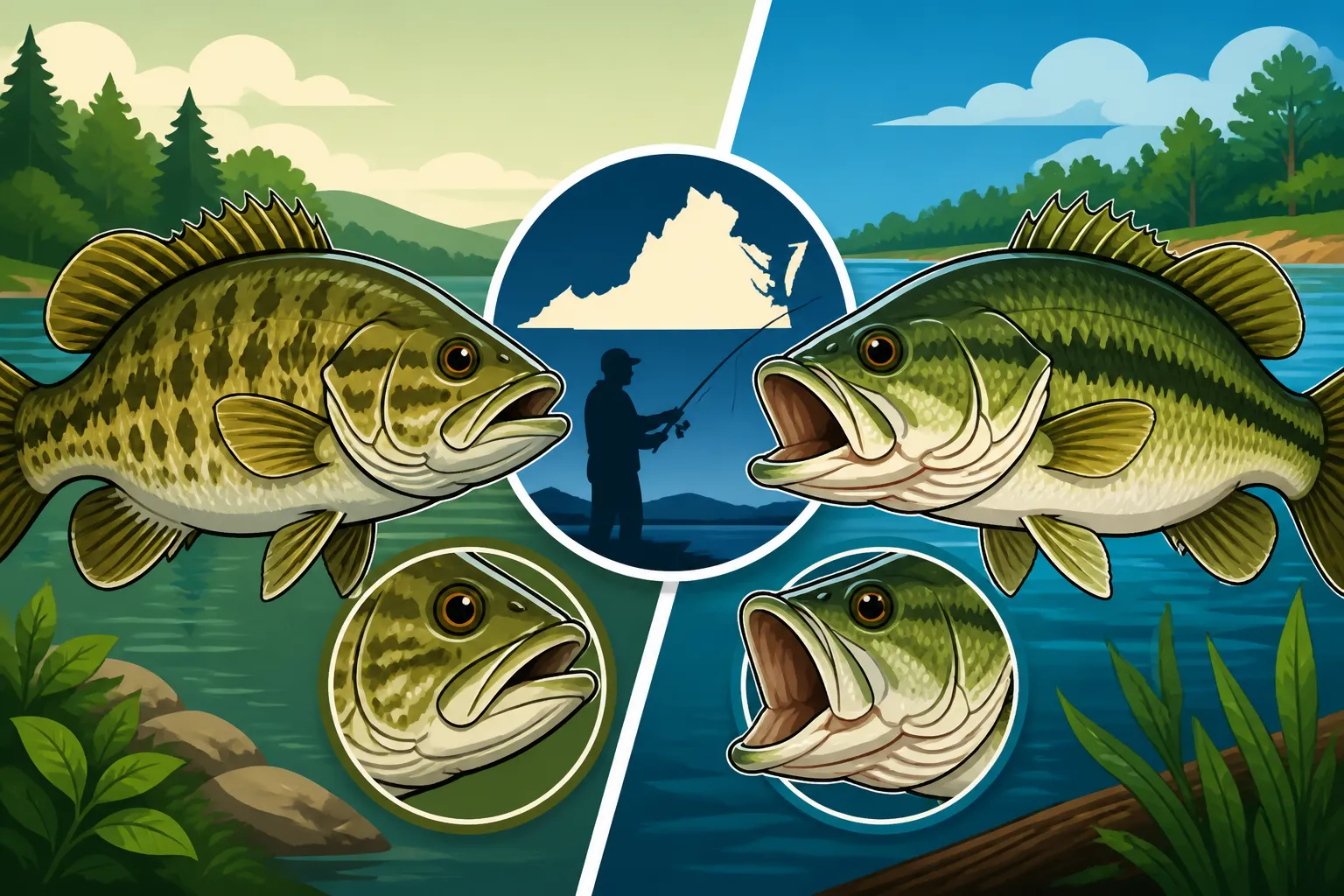
Spotted Bass vs Largemouth Bass: How Virginia Anglers Tell Them Apart
There's nothing quite like the thrill of a bass hitting your line, feeling that unmistakable tug, and reeling in a feisty fighter. But for many anglers, especially here in Virginia where our waters are teeming with diverse species, there's often a moment of pause once that fish is in the boat or on the bank: "Is this a largemouth… or a spotted bass?" It's a common, understandable confusion, and honestly, even seasoned pros can sometimes do a double-take. Getting it right isn't just about bragging rights; it's about understanding the specific regulations for the waters you're fishing and appreciating the unique characteristics of each species. This guide is here to help you confidently tell the difference between these two fantastic Virginia sportfish.
Why Accurate Bass Identification Matters for Virginia Anglers
Let's be real, when you're out on the water, you just want to fish! The last thing you want to be doing is squinting at a fish trying to remember biological jargon. But accurately identifying your catch, particularly between species like largemouth and spotted bass, isn't just an academic exercise; it has real-world implications for your fishing success, legal compliance, and even how you think about conservation.
Understanding Virginia's Fishing Regulations
Virginia's Department of Wildlife Resources (DWR) sets specific regulations for different fish species, and sometimes, those regulations can vary by water body. While largemouth and spotted bass often fall under similar general bass regulations in many areas, there can be nuances. For instance, specific slot limits, daily creel limits, or length restrictions might apply differently if one species is more prevalent or of greater conservation concern in a particular lake or river. Imagine catching a beautiful bass, only to realize later that you've unintentionally kept a fish that was out of season or below the legal length for its specific species in that particular body of water. That's a headache you definitely want to avoid. Knowing exactly what you've caught ensures you're always fishing within the rules, keeping your fishing experience enjoyable and penalty-free. Many anglers find it helpful to keep a quick reference guide or use a reliable fish identification app on their phone. Even a simple, waterproof guide from a tackle shop or a laminated printout of Virginia Fishing Regulations Explained can save a lot of guesswork.
Tailoring Your Fishing Techniques
Beyond regulations, knowing your fish helps you become a better angler. Largemouth and spotted bass, while both "bass," have distinct preferences when it comes to habitat, forage, and how they react to different lures and presentations. A largemouth, famous for lurking in thick cover, might crush a Texas-rigged worm or a frog thrown into lily pads. A spotted bass, on the other hand, often prefers deeper, clearer water and might be more inclined to chase a crankbait or a jig fished along rocky points or humps. If you consistently fish a lake known for a strong spotted bass population with tactics primarily designed for largemouths, you might be missing out on a lot of bites. By understanding which species you're catching (and where), you can refine your approach, choose the right Best Bait for Largemouth Bass in Virginia or Best Bait for Spotted Bass at Claytor Lake, Virginia, and dramatically increase your chances of a successful day on the water.
Contributing to Conservation Efforts
Every angler plays a role in conservation. Accurate fish identification, especially when participating in catch-and-release, helps ensure healthy fish populations for future generations. When you know what you've caught, you can practice proper handling techniques specific to that species, and if you're keeping fish, you can do so responsibly within legal limits. Furthermore, biologists rely on angler reports and creel surveys to monitor fish populations. If everyone incorrectly identifies their catch, that data becomes less reliable, potentially impacting management decisions. So, while it might seem like a small detail, taking the time to correctly identify your bass is a valuable contribution to the ongoing health of Virginia's fisheries.
The Classic Ambush Predator: Largemouth Bass
The largemouth bass is probably what comes to mind for most people when they think of bass fishing. It's truly iconic, known for its aggressive nature and powerful fights. In Virginia, it's one of our most sought-after freshwater game fish, thriving in a wide range of habitats across the state.
Distinctive Physical Characteristics
When you pull a largemouth bass from the water, the first thing that usually jumps out at you is its mouth – it's huge! Hence the name "largemouth." If you close the fish's mouth, the hinge of its jaw will extend beyond the rear edge of its eye. This is a primary differentiator from its spotted cousin. Another key feature is its lateral line, the faint line running horizontally along its side. On a largemouth, this line is typically more broken or irregular, often forming a series of distinct dark blotches or a jagged stripe, rather than a smooth, continuous band.
Their overall body coloration can vary quite a bit depending on the water clarity and bottom composition of where they live. They tend to be dark green to olive on top, fading to lighter green or white on their belly. The dark lateral line is almost always visible, though sometimes it can be quite muted. The largemouth also has a very distinct dorsal fin, with a deep notch separating the spiny front section from the softer-rayed back section. Sometimes, you can even put a finger through that notch, almost dividing the fin into two separate parts. You might also notice that the scales on a largemouth tend to be larger and more uniform across its body compared to a spotted bass. Learning How to Identify a Largemouth Bass in Virginia is a great first step to becoming a more informed angler.
Preferred Habitat and Behavior
Largemouth bass are masters of ambush. They absolutely love structure and cover, using it to hide and surprise their prey. Think about those classic bass fishing scenes: a largemouth blowing up on a topwater frog cast deep into lily pads, or ripping a spinnerbait from a submerged brush pile. They gravitate towards weed beds, fallen trees, docks, stumps, submerged rock piles, and any kind of heavy cover that offers both protection and a prime spot to lie in wait. They prefer warmer, shallower waters than some other bass species, making them a common sight in ponds, lakes, and the slower-moving sections of rivers.
Their behavior is typically territorial. A big largemouth will often claim a piece of prime real estate – say, a prominent stump or a dense patch of hydrilla – and defend it vigorously. They are opportunistic feeders, preying on anything from baitfish and crayfish to frogs, snakes, and even small birds or rodents that fall into the water. This aggressive, territorial nature is what makes them so much fun to target with a wide array of lures, from big lipless crankbaits to hefty swimbaits. During the spawn, they'll build nests in shallow, protected areas, guarding their eggs and fry aggressively. This period is a fantastic time for Spring Bass Fishing Patterns, though it's important to practice catch and release to protect the future of the fishery.
The Sneaky One: Spotted Bass
Often mistaken for a largemouth, the spotted bass (also known as a "spot" or "Kentucky bass" in some regions) is a truly unique and powerful game fish found in many Virginia waters. While they share some similarities with largemouths, paying attention to a few key features will help you identify them correctly.
Distinctive Physical Characteristics
When you catch a spotted bass, the first thing to inspect is, again, its mouth. Unlike the largemouth, the spotted bass's jaw, when closed, will typically not extend beyond the rear edge of its eye. It will end either directly under the eye or slightly before it. This is a very reliable initial indicator. Then, look closely at its lateral line. On a spotted bass, this dark line is generally more continuous and smooth, without the dramatic breaks or blotches often seen on a largemouth.
Perhaps the most telling characteristic, and where it gets its name, is the presence of distinct rows of small, dark spots (often appearing as tiny, diamond-shaped marks) below its lateral line on its lower sides. These spots are usually quite clear and can be felt if you run your finger lightly against the scales. Another important, though sometimes harder to see, feature is a patch of small teeth on the tongue. If you gently open the fish's mouth and feel the middle of its tongue with your finger, you'll likely feel a rough patch on a spotted bass. A largemouth bass will have a smooth tongue. These spots and the rough tongue patch are definitive identifiers. The spotted bass also typically has a less pronounced notch in its dorsal fin compared to the largemouth, making the spiny and soft-rayed sections appear more connected. For a deeper dive into these nuanced differences, check out Spotted Bass vs Largemouth Bass: How Virginia Anglers Tell Them Apart.
Preferred Habitat and Behavior
Spotted bass tend to prefer different environments than largemouths. While they'll occasionally overlap, you're more likely to find spots in clearer, deeper, and often rockier waters. They thrive in rivers and streams with moderate current, and in the deeper, open water sections of larger reservoirs. Instead of dense weed beds or heavy timber, they often relate to offshore structure like main lake points, submerged humps, ledges, and rocky bottom transitions. Think about the clear, rocky waters of a lake like Claytor Lake – that's prime spotted bass territory in Virginia. They're often found schooled up, especially during the colder months, making them a target for anglers using electronics to find deep concentrations of fish.
In terms of behavior, spotted bass are often described as acting more like smallmouth bass in their feeding habits. They are typically less aggressive in their strike than a largemouth, often "pecking" at a bait before fully committing. They are highly predatory, feeding on baitfish, crayfish, and insects. While they don't grow to the massive sizes of some trophy largemouths, they are known for their strong, sustained fights, often pulling hard and staying deep, rather than making the big jumps characteristic of largemouths. Targeting them often involves different strategies, such as using finesse techniques, small crankbaits, or jigs in deeper water. Knowing these behavioral patterns can significantly impact your success when fishing specific Virginia lakes.
Visual Cues: Spotting the Differences Side-by-Side
Alright, let's get down to brass tacks. You've got a fish in hand, and you need to make a quick, accurate identification. While all the descriptions are helpful, sometimes seeing them laid out in a comparative format is the best way to solidify the knowledge. Pay close attention to these key areas.
Jawline and Eye Placement
This is often the most straightforward and reliable visual test.
- Largemouth Bass: The maxillary (the upper jawbone) extends significantly past the rear edge of the eye when the mouth is closed. Imagine drawing a vertical line down from the back of the eye; the jawline will clearly cross this line. This gives the largemouth its characteristic "bucket mouth" appearance.
- Spotted Bass: The maxillary ends either directly beneath the rear edge of the eye or just slightly behind it. It typically does not extend significantly past the eye. This is a subtle but crucial difference. If you're unsure, try to get a clear side profile of the fish's head. This single feature is usually enough to tell them apart, even without looking at other characteristics.
Lateral Line and Body Markings
Both species have a lateral line, but how it's expressed and what other markings accompany it are important clues.
- Largemouth Bass: The lateral line on a largemouth is often a series of dark, irregular blotches or a jagged, broken horizontal stripe. It's not usually a smooth, continuous line. The body below the lateral line is generally plain or might have faint, irregular mottling. You won't typically find distinct rows of spots on the lower flanks.
- Spotted Bass: The lateral line is generally more continuous and well-defined, appearing as a more solid dark band. More importantly, look below this lateral line. Spotted bass have distinct rows of small, dark, often diamond-shaped spots that run along their lower sides, down towards the belly. These spots are usually quite prominent and give the fish a "spotted" appearance that largemouths lack. If you see those clear rows of spots, you've got a spot! This feature is a dead giveaway.
Tongue Patch and Dorsal Fin Notch
These are internal and fin-related characteristics that provide definitive answers.
- Largemouth Bass: If you gently feel the middle of a largemouth bass's tongue with your finger, it will feel smooth. There is no rough patch of teeth. Their dorsal fin has a very deep, almost complete separation between the spiny front section and the softer-rayed rear section. You can usually lay a finger sideways into this notch.
- Spotted Bass: A key identifier for the spotted bass is the presence of a distinct patch of small, rough teeth on its tongue. Gently run your finger over the tongue, and you'll feel it. This is a rock-solid distinguishing feature. Their dorsal fin has a less pronounced, shallower notch, making the two sections appear more connected. It's not a deep, finger-fitting groove like on the largemouth.
Here’s a quick reference table to help you identify these differences at a glance:
| Feature | Largemouth Bass | Spotted Bass |
|---|---|---|
| Jawline | Extends significantly past the rear edge of the eye. | Ends directly under or slightly behind the rear edge of the eye. |
| Lateral Line | Often broken, irregular blotches, or jagged stripe. | More continuous, solid line, with distinct rows of dark spots below. |
| Tongue | Smooth. | Rough patch of small teeth present. |
| Dorsal Fin | Deep, almost complete notch separating fin sections. | Shallower notch, fin sections appear more connected. |
| Body Shape | More robust, deeper body. | Typically more slender, torpedo-shaped. |
| Scales | Larger, more uniform scales. | Smaller scales, especially on the cheek and operculum. |
When you're out on the water, try to run through this mental checklist. It gets easier with practice, and soon you'll be able to tell them apart in an instant!
Habitat and Behavior Clues: Beyond the Visual
Sometimes, visual identification isn't immediately clear, especially with smaller fish or those that exhibit unusual coloration. This is where understanding their preferred hangouts and how they typically act can give you valuable hints. Think of it as detective work, where the environment and the fish's fighting style offer further evidence.
Where You Find Them: Habitat Preferences
The old adage "match the hatch" isn't just about lures; it's also about understanding the fish's environment. Largemouth and spotted bass, while sometimes overlapping, generally prefer different types of real estate.
Largemouth Bass Hotspots:
If you're pulling fish out of dense submerged vegetation, lily pads, thick cattails along a shallow bank, or from beneath fallen trees and docks, chances are you're in largemouth country. They love cover and warmer, shallower water. Lakes like Smith Mountain Lake have fantastic largemouth populations that hug the shorelines and structures. They are ambush predators, so they want places to hide and dart out from. If your fishing trip focuses on quiet coves, backwater sloughs, or the edges of dense weed lines, you're likely targeting largemouths. This preference means that if you're throwing a weedless frog into a dense mat of hydrilla and get a strike, you can strongly suspect it's a largemouth before you even see it. They are less tolerant of strong currents and generally prefer still or slow-moving water bodies.
Spotted Bass Territory:
On the flip side, if you're fishing in deeper, clearer water, especially around rocky points, bluff walls, submerged humps, ledges, or in sections of rivers with noticeable current, you're more likely to encounter spotted bass. Lakes such as Claytor Lake are known for their strong spotted bass populations, which often relate to the deeper, rockier structures. Spots are more comfortable in open water and greater depths than largemouths. They often suspend over deep water or school up along structure, behaving more like their smallmouth cousins. If you're scanning your fish finder for bait balls suspended over 20-30 feet of water and then dropping jigs or spoons, the fish you hook are probably spots. They are also much more at home in flowing water, so if you're fishing a medium-sized river with a noticeable current and catching bass, especially around gravel bars or rocky shoals, a spotted bass is a strong possibility. Understanding Where to Find Spotted Bass in Virginia is key to targeting them effectively.
How They Fight: The Tell-Tale Tug
While every fish is an individual and fights differently based on its size and mood, there are general tendencies that can offer a clue about the species at the end of your line.
Largemouth Bass Fight:
A largemouth bass strike is often explosive. They hit hard, frequently ripping line off your reel and making powerful, head-shaking runs. Their most iconic fighting characteristic is the jump. Many largemouths will breach the surface, trying to throw the hook with violent head shakes. This aerial display is thrilling and is a pretty good indicator you've got a largemouth on. They tend to use their broad, flat bodies to leverage against the line, giving you a strong, heavy pull. They might also try to bury themselves in cover if they can, hence the importance of a stout rod and strong line when fishing heavy vegetation.
Spotted Bass Fight:
Spotted bass, while smaller on average than largemouths, are known for their incredible stamina and relentless fight. They typically make more sustained, deep runs rather than spectacular jumps. They pull hard and consistently, often staying low in the water column and exhibiting a powerful, bulldog-like tug. They might try to dive under the boat or run for deeper water, really testing your drag system. Their fight is often described as "dirty," meaning they'll use every trick in the book to shake the hook without coming to the surface. If you're reeling in a bass that feels incredibly strong for its size, making run after run without ever showing itself on the surface, there's a good chance you've hooked a spotted bass. While some will jump, it's far less common and less dramatic than a largemouth's acrobatics.
By combining visual identification with these habitat and behavioral clues, you'll become a much more adept bass identifier on the water.
Fishing Tactics: Tailoring Your Approach for Each Species
Once you start consistently telling the difference between largemouth and spotted bass, you'll find that your fishing strategies will naturally evolve. Adapting your lures, techniques, and even your approach to different water bodies can dramatically improve your catch rate.
Lures and Presentations for Largemouths
Since largemouths are ambush predators that love cover and shallow, warmer water, your lure choices and presentations should reflect that. Think about baits that can be worked through or around structure, or that mimic their preferred prey in those environments.
- Heavy Cover Options: For thick grass, lily pads, or brush, weedless presentations are key. Texas-rigged soft plastics (worms, creature baits, flukes) are perfect for punching through vegetation. Topwater frogs, hollow-bodied lures that glide over mats, and buzzbaits can draw explosive strikes when fished over heavy cover. You'll often need heavier line and a stout rod, easily found on platforms like Amazon, to muscle these fish out of their hiding spots.
- Targeting Structure: Crankbaits that dive to specific depths, spinnerbaits with flash and vibration, and jigs (especially those tipped with a craw trailer) are excellent for fishing around docks, fallen timber, and rocky banks. These baits imitate baitfish or crayfish, which are common prey for largemouths patrolling these areas.
- Versatility is Key: Don't forget the classic plastic worm, which can be fished in countless ways – Carolina-rigged, Wacky-rigged, or Texas-rigged – to entice a largemouth in almost any situation. The key is often to get your bait right in their face, or make enough commotion to draw them out of their lair. For more in-depth strategies, check out How to Catch Largemouth Bass Year-Round.
Lures and Presentations for Spotted Bass
Spotted bass, with their preference for deeper, clearer, and often rockier water, along with a tendency to school, respond well to different tactics. Finesse, speed, and baits that imitate small baitfish are often more effective.
- Deeper Water Techniques: Jigs (especially football jigs or casting jigs with craw trailers) are fantastic for bouncing along rocky bottoms, humps, and ledges where spots congregate. Drop-shot rigs, shaky heads, and Ned rigs are excellent finesse techniques for presenting small soft plastics to schooling fish in deeper water, particularly when the bite is tough.
- Open Water & Current: Small crankbaits, jerkbaits, and blade baits that mimic shad or minnows are highly effective for spots that are actively chasing baitfish in open water or along current breaks. Spinnerbaits and small swimbaits can also be productive. Spotted bass often feed on schools of baitfish, so lures that imitate these small prey items are generally a good bet.
- Schooling Behavior: Because spotted bass often school, if you catch one, there are likely more in the area. Your fish finder, often equipped with advanced sonar features (many brands offer great portable options on Amazon), will be an invaluable tool for locating these schools. Once you find them, vertical jigging with spoons or small jigs can be incredibly effective. Consider reading more about Fishing the James River in Virginia or Fishing the Shenandoah River in Virginia, as these rivers are known for their spotted bass populations.
General Tips for Both Species
Regardless of which bass species you're after, always pay attention to water temperature, clarity, and time of year. Bass behavior, whether largemouth or spotted, is heavily influenced by these factors. A quality pair of polarized sunglasses will help you spot subtle movements or changes in structure underwater, giving you an edge. And of course, practice catch and release, especially for larger breeding fish, to ensure these incredible fisheries remain strong for generations to come. Having a good quality fishing scale, widely available on Amazon, can help you quickly weigh your catch before a responsible release.
Becoming proficient at identifying largemouth and spotted bass takes a bit of practice, but with these tips and a keen eye, you'll be confidently calling your catches in no time. Happy fishing!
Disclaimer
This article is for general informational purposes only and does not constitute professional advice. Laws, prices and regulations vary by location and change over time. Consult a qualified professional for guidance on your specific situation.