How to Choose Lure Color for Murky Water
There’s nothing quite as frustrating as heading out to your favorite fishing spot, rod in hand, only to find the water looking like chocolate milk after a heavy rain or a sudden influx of sediment. Many anglers, especially those new to Virginia's diverse waterways, often stand there wondering if they should even bother, let alone what lure to tie on. This guide is here to demystify the art of choosing the right lure color for murky water, helping you turn those challenging conditions into successful fishing adventures.
Understanding Murky Water and Its Impact on Fish Behavior
Murky water isn't just a nuisance; it fundamentally changes the underwater environment and, consequently, how fish see and react to their prey. When visibility is poor, fish rely more heavily on their other senses – like their lateral line system to detect vibrations and their sense of smell – to locate food. This shift in sensory reliance means your lure needs to do more than just look pretty; it needs to be felt and, often, smelled.
What Causes Murky Water in Virginia?
Virginia's landscape is incredibly varied, from the red clay hills of the Piedmont to the rich tidal rivers flowing into the Chesapeake Bay. This variety means murky water can come from a few different sources, each with slightly different implications for your fishing strategy. Heavy rainfall is a prime culprit, washing sediment, soil, and organic debris into rivers and lakes, turning clear water opaque. This is especially true after a prolonged dry spell when the ground is hard and runoff is maximized. Rivers like the James or the Rappahannock can get particularly stained after a good downpour.
Another common cause is wind. Strong winds can churn up shallow lake bottoms, suspending fine particles of silt and organic matter, reducing visibility even without rain. Think about fishing a large, shallow lake like parts of Lake Anna or Lake Gaston on a windy day; the water can go from clear to cloudy in a matter of hours. Agricultural runoff, although less common in recreational fishing areas, can also introduce suspended particles and nutrients that impact water clarity. Finally, certain types of lake beds, especially those with fine clay or silt, are naturally more prone to becoming turbid. Understanding why the water is murky can sometimes give you a clue about its duration and the type of particles in it, which subtly affects fish behavior.
How Murky Water Affects Fish Vision
Fish don't see the world quite like we do. Their vision is adapted to the aquatic environment, and different species have varying capabilities. In murky water, light penetration is significantly reduced. This means that colors that appear vibrant in clear water might become dull, distorted, or even disappear entirely just a few feet below the surface. Reds, for instance, are the first colors to be absorbed by water, even clear water, so they quickly lose their color in murky conditions, appearing black or grey to fish. Blues and greens penetrate deeper, but in truly muddy water, even these might struggle to retain their vibrancy.
Fish are often sight predators, so when their vision is compromised, they switch gears. They become more reactive to movement, vibration, and scent. This is why a lure that displaces a lot of water or rattles loudly can be far more effective than a subtle, naturally colored bait, regardless of how realistic it looks. It's a fundamental shift in strategy, moving from an "eat with your eyes" approach to an "eat with your lateral line and nose" approach. Therefore, when you're selecting a lure, you need to think less about matching the hatch visually and more about creating a commotion and a silhouette that fish can detect through the murk. This is also why How to Choose Lure Color for Clear Water involves a completely different set of principles.
The Science of Lure Color in Low Visibility
Choosing a lure color for murky water isn't just about picking something bright. There's a bit of science involved that can really help you stack the odds in your favor. It boils down to understanding light penetration, contrast, and fish psychology in challenging conditions.
High Contrast vs. Bright Colors
One of the biggest misconceptions is that you always need the brightest colors for murky water. While bright colors can be effective, especially fluorescent ones, the real key often lies in contrast. Imagine trying to spot a bright yellow ball against a bright yellow wall in a dimly lit room; it might be bright, but it lacks definition. Now imagine a black ball against that same bright yellow wall – much easier to spot, right?
The same principle applies underwater. In turbid conditions, fish are looking for a clear silhouette or a stark difference against the backdrop of the cloudy water. This is why black, or very dark colors, can be incredibly effective, especially when paired with a bright accent like chartreuse or orange. A black jig with a chartreuse tail, for example, offers that striking contrast that fish can pick up on, even if the actual colors are muted. The black creates a strong profile, and the chartreuse adds a visible "pop" that can catch their attention. This contrast helps fish define the shape of your lure, making it easier to pinpoint and strike.
Fluorescent and UV-Reactive Lures
Fluorescent colors are often touted as miracle workers in murky conditions, and for good reason. Unlike regular pigments that simply reflect visible light, fluorescent materials absorb higher-energy light (like UV light, which penetrates deeper into water than visible light) and then re-emit it as lower-energy, visible light. This means they literally appear to glow or radiate light, making them much more visible in low-light conditions. Chartreuse, often described as a vibrant yellow-green, is a classic example. It's incredibly effective in stained water because it seems to punch through the murk better than other colors.
Similarly, some lures are designed to be UV-reactive, meaning they reflect ultraviolet light. While humans can't see UV light, many fish species can, making these lures stand out even when the visible light spectrum is heavily absorbed by the water. When combined with loud rattles or strong vibrations, fluorescent and UV-reactive lures create a powerful combination for attracting fish in murky environments. Always keep a few chartreuse or fluorescent orange options in your tackle box for those challenging days on places like the Roanoke River or when fishing a pond after a heavy rain. You can find a vast array of these specialized lures on Amazon to add to your collection.
Natural Colors and Their Role (or Lack Thereof)
So, what about natural colors – the greens, browns, and subtle patterns that mimic real baitfish? In clear water, these are often deadly, perfectly blending in and fooling wary fish. However, in truly murky or muddy water, their effectiveness plummets. The very subtlety that makes them so good in clear water works against them here. Without good light penetration, those intricate patterns and realistic hues simply disappear. A natural-colored crankbait that looks exactly like a minnow in clear water will just be a dark, indistinguishable blob in muddy water.
There are exceptions, of course. If the water is only slightly stained, a natural color with a strong action might still elicit strikes. But as a general rule, when you're dealing with genuine murk, it's time to put away the realistic patterns and reach for something that screams "I'm here!" This is a key difference between selecting lures for different water clarities, as highlighted in guides like How to Choose Lure Color for Clear Water. Don't be afraid to experiment, but trust that in low visibility, drawing attention is paramount over realism.
Top Lure Colors for Different Murky Water Scenarios in Virginia
Virginia anglers encounter murky water in many forms, from slightly stained tidal rivers to heavily muddied mountain lakes after a spring storm. The "best" color can vary slightly depending on the specific murkiness level and the target species. Here, we break down some go-to colors and scenarios.
Extremely Muddy Water (Zero Visibility)
When the water looks like coffee with cream, or even just straight mud, visibility is practically zero. In these conditions, fish are relying almost entirely on their lateral line system to detect vibrations and their sense of smell. Color becomes less about what they see and more about creating a strong silhouette and vibration.
Your best bet here is often a dark, solid color that creates a stark profile against the minimal light. Black is king in these situations, sometimes paired with a small flash of blue or purple, though the black does most of the work. A black jig or a black worm fished slowly can be incredibly effective. The idea isn't for the fish to admire the color, but to perceive a large, dark shape moving through the water that looks like a potential meal. Lures that displace a lot of water, like spinnerbaits with large thumping blades (e.g., Colorado blades) or rattling crankbaits, are also excellent choices. The vibrations act as a sonar beacon, guiding the fish to your offering. Consider a large, dark worm with a heavy rattle inserted, or a dark-colored ChatterBait for maximum thump. For largemouth bass, especially after a heavy rain, this can be a game-changer. How to Catch Bass in Muddy Water After Rain offers even more specific advice on this.
Stained Water (Low Visibility, but not opaque)
Stained water is more common than truly muddy water and offers a bit more flexibility in lure choice. Here, fish can still perceive some color and contrast, but muted tones will still struggle. This is where those vibrant, high-contrast, and fluorescent colors really shine.
Chartreuse: This is arguably the most versatile and effective color for stained water. Its unique fluorescent properties allow it to penetrate the water better than many other hues, making it highly visible to fish. Whether it's a chartreuse spinnerbait, crankbait, jig, or even a chartreuse tail on a soft plastic, it's a must-have. When targeting crappie in stained brush piles in places like Smith Mountain Lake, a small chartreuse jig can be irresistible.
Orange/Red: While pure red loses its color quickly, vibrant oranges and red-orange combinations can be surprisingly effective, especially in water that has a brownish or tannic stain. These colors can mimic crawfish, a primary food source for many species. A red or orange crankbait fished in stained reservoir arms can provoke aggressive strikes from bass.
Black/Blue: This combination offers excellent contrast and often performs well in water that has a dark, stained appearance. The black provides the silhouette, and the blue adds a subtle color pop that bass seem to love. A black and blue jig with a matching trailer is a classic combination for pitching into cover in stained water. Many anglers swear by a black and blue skirted jig for targeting sluggish bass in the cooler, murkier parts of the season.
White: Believe it or not, plain white or pearl can be incredibly effective in stained water, especially on overcast days. White offers a strong, clean contrast against dark water and can imitate various baitfish. A white spinnerbait or a pearl swimbait can draw attention when other colors fail. For example, some seasoned anglers on the tidal James River will throw a white soft plastic jig for striped bass (rockfish) when the water is stained but not completely opaque.
Here's a quick reference table for choosing colors in murky water:
| Water Condition | Best Lure Colors | Primary Reason | Lure Type Examples |
|---|---|---|---|
| Extremely Muddy | Black, Dark Blue, Dark Purple | Strong silhouette, high contrast, minimal light | Jigs, Dark Worms, Spinnerbaits (Colorado Blade) |
| Heavily Stained | Chartreuse, Fluorescent Orange, Black/Blue | High visibility, fluorescent properties, contrast | Crankbaits, Jigs, Spinnerbaits, Soft Plastics |
| Lightly Stained/Tannic | White, Pearl, Bright Yellow, Chartreuse, Red/Orange | Good contrast, mimic baitfish, some visibility | Spinnerbaits, ChatterBaits, Crankbaits |
| Overcast/Low Light | White, Pearl, Bright Yellow, Chartreuse | Maximize visible light reflection | Topwater, Spinnerbaits, Jerkbaits |
Color Selection for Specific Virginia Species in Murky Water
Different fish species react to colors and presentations in unique ways, even in murky water. Knowing your target can help fine-tune your lure choice.
Largemouth Bass
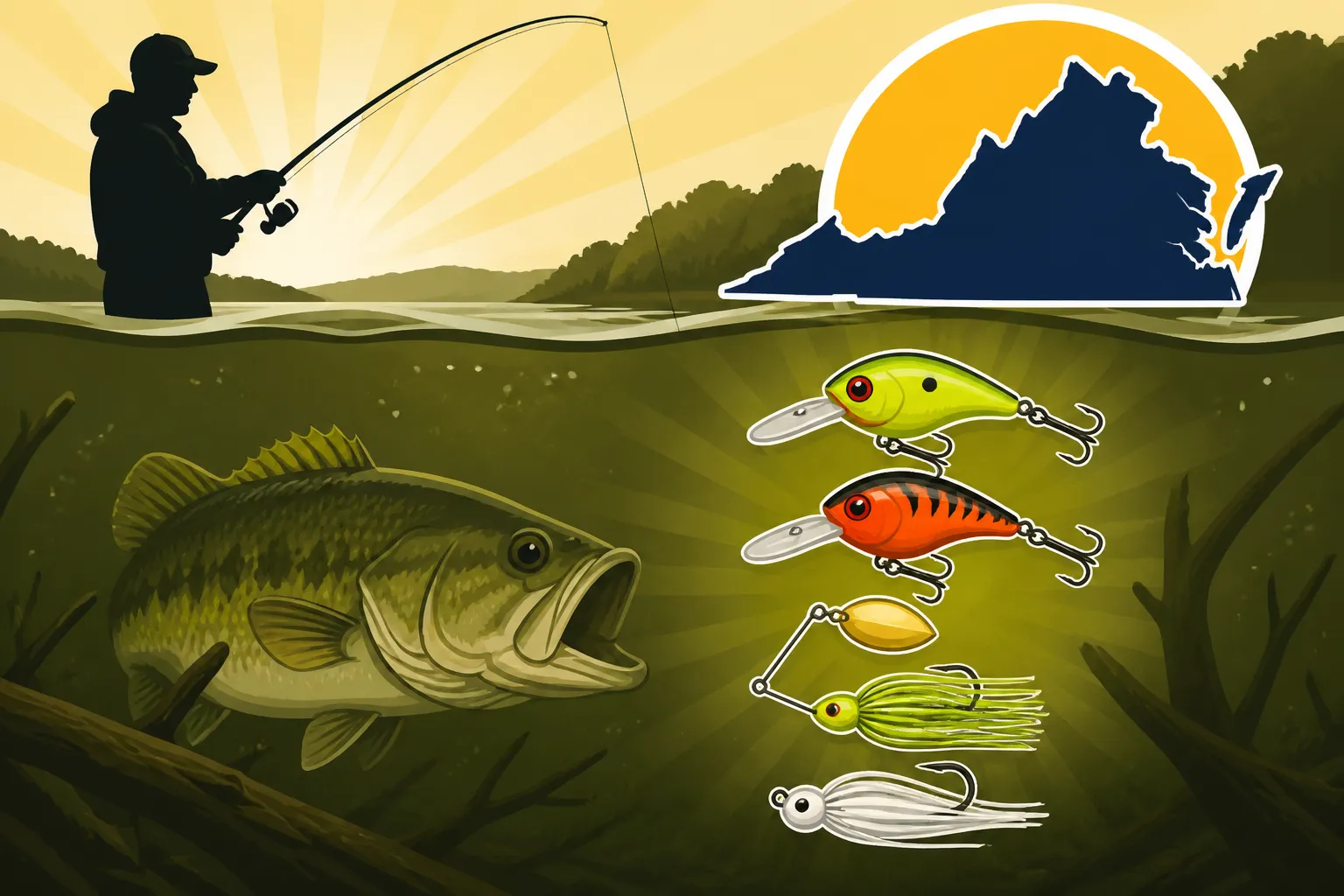
Virginia's largemouth bass are opportunistic predators and often thrive in stained or murky environments. For them, chartreuse, black and blue, and bright orange/red are top contenders. Think about a chartreuse spinnerbait with large thumping blades for covering water, or a black and blue jig slowly worked through submerged cover. Rattling crankbaits in bright colors are also fantastic for eliciting reaction strikes. The more noise and vibration you can create, the better. Many anglers keep a variety of these colors handy. You can usually find a good selection of specialized bass lures on Amazon for all conditions.
Smallmouth Bass
Smallmouth bass typically prefer clearer, rockier waters, but you'll find them in stained sections of rivers like the Shenandoah or the New River, especially after rain. When the water gets turbid, smallmouths become less aggressive sight feeders. Focus on lures that offer strong vibrations and a good silhouette. Dark browns, black, and dark green pumpkin can work for soft plastics, especially if they have some glitter or a bright tail. Small crankbaits or tubes in these dark colors can entice strikes. If the stain isn't too severe, some smallmouth might still hit a white or chartreuse spinnerbait. Don't forget that Best Bait for Smallmouth Bass in Virginia offers great specific advice.
Crappie
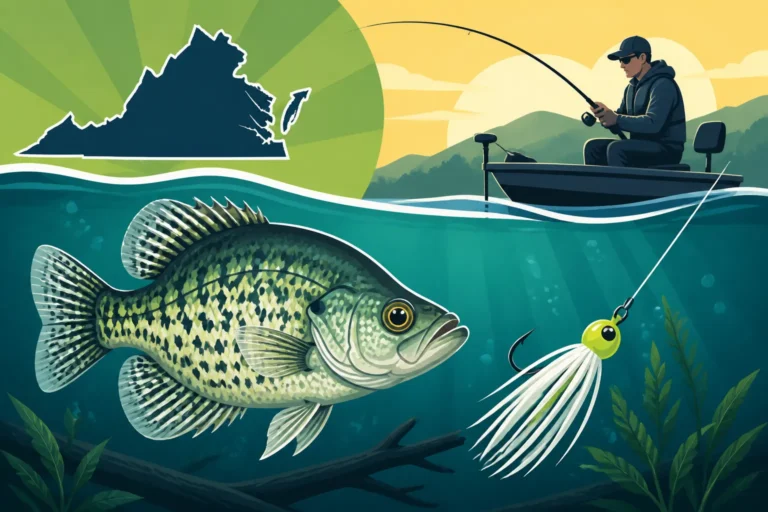
Crappie are notorious for schooling up in cover, and they can be found in stained waters in many Virginia lakes and ponds. For them, small jigs are often key. Chartreuse, white, and bright yellow are stellar choices. Often, crappie will hit a tiny jig in chartreuse or white, tipped with a small minnow for added scent. The contrast of the bright jig against the dark water helps them pinpoint the lure. When the bite is tough, a tiny chartreuse tube jig under a bobber in a stained creek arm can be deadly. Learn more about their preferences in Crappie Fishing Techniques for Beginners.
Catfish
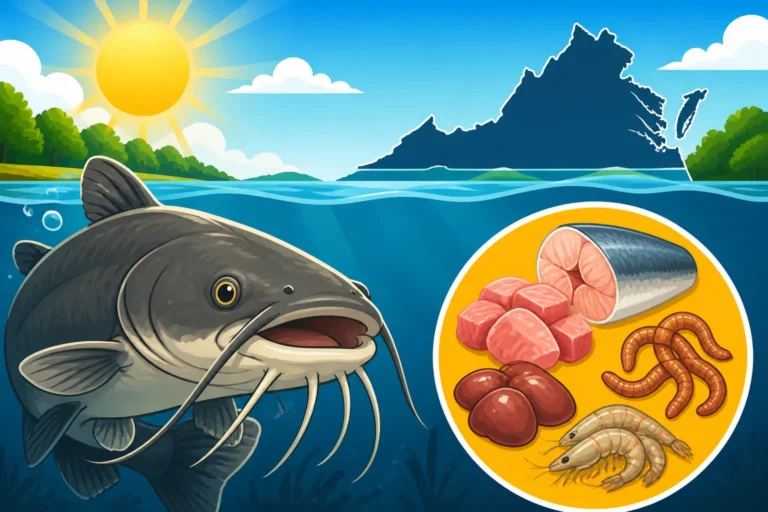
Catfish are the ultimate murky water specialists, relying almost entirely on scent and their barbels to locate food. While color isn't as critical for them, using a darker lure or bait can sometimes create a more noticeable profile. More importantly, focus on strongly scented baits. Cut bait, chicken livers, or specific commercial catfish baits are far more important than the color of your hook or sinker. However, if you're using artificials for channel cats, a dark jig head or a dark soft plastic that absorbs scent well might be slightly advantageous. For flathead catfish, live bait or large chunks of cut bait presented near structure in murky river bends are usually the ticket. You can find detailed strategies in Catfish Fishing Techniques and Bait Guide.
Adjusting Your Presentation in Murky Water
Choosing the right color is only half the battle. How you present that lure in murky water is just as critical, if not more so, than the hue itself. Fish aren't just looking for something to eat; they're looking for something they can find and catch.
Slow Down Your Retrieve
When visibility is low, fish have less time to react to a fast-moving lure. They need more time to locate it, identify it, and commit to a strike. Therefore, a slower retrieve is almost always more effective in murky water. This applies to nearly all lure types, from crankbaits to soft plastics. Instead of a rapid crank-and-pause, try a slower, more deliberate retrieve with longer pauses. For jigs and worms, let them sit on the bottom for extended periods, shaking them subtly to create localized vibrations.
This slower pace gives fish the opportunity to follow the scent trail, track the vibrations with their lateral line, and eventually close in for the strike. It also allows your lure to stay in the strike zone longer, increasing the chances of an encounter. Don't be afraid to experiment with extreme slowness; sometimes, the subtle movement is what triggers a bite from a hesitant fish. Many of the techniques discussed in Fishing Techniques After a Cold Front also apply here, as cold fronts often make fish less aggressive, similar to how murky water affects them.
Increase Noise and Vibration
As mentioned earlier, fish rely heavily on their lateral line in murky water. This means any lure that creates significant noise or vibration is going to be more effective.
Rattles: Many lures come with internal rattles, and for good reason. The sound waves travel through the water, attracting fish from a distance. If your favorite lure doesn't have a rattle, you can often insert aftermarket rattles into soft plastics or even attach them to jigs.
Blade Type (Spinnerbaits): When using spinnerbaits, opt for larger blades, especially Colorado blades. These create more thump and vibration than willowleaf or Indiana blades, making them easier for fish to detect in the murk. The flash of a silver or gold blade can also provide a brief, noticeable glimmer.
Water Displacement: Lures with a wider profile, like wide-wobbling crankbaits or ChatterBaits, move more water, sending out stronger vibrations. These are excellent choices for dirty water because they announce their presence effectively. Topwater lures that create a lot of splash and gurgle, like buzzbaits or poppers, can also be surprisingly effective in low light or stained conditions, as the fish are tracking the surface commotion.
Focus on Scent
While color and vibration help fish find your lure, scent can be the final trigger that convinces them to bite and hold on. This is particularly true for species like catfish, but also for bass and crappie.
Scent Additives: Many anglers will apply scent to their soft plastics, jigs, and even crankbaits. There's a huge variety of commercially available fish attractants that mimic natural prey or stimulate fish appetite. Applying a generous amount of scent can leave a trail that fish can follow, giving them extra motivation to investigate your lure.
Scented Lures: Some soft plastics come pre-impregnated with scent. Brands like Berkley PowerBait or Strike King Rage Tail are designed with this in mind, releasing a scent trail as they move through the water. For bass, a scented creature bait or worm in a dark color can be deadly in stained water.
In murky conditions, combining a high-contrast, vibrating lure with an added scent can create an irresistible package for fish. Remember that the goal is to make your lure as easy to find and as appealing as possible when visual cues are limited. This approach helps you overcome the challenges presented by conditions often found in Virginia's fishing spots.
Conclusion
Fishing in murky water can be intimidating, but it doesn't have to be a lost cause. By understanding how low visibility affects fish and adapting your lure choices and presentation techniques, you can still have incredibly productive days on Virginia's lakes, rivers, and tidal estuaries. Focus on high contrast, vibrant and fluorescent colors, and lures that create plenty of noise and vibration. Don't forget to slow down your retrieve and add scent whenever possible. Experimentation is key, but with these strategies in your tackle box, you'll be well-equipped to tackle whatever Mother Nature throws at you. So next time the water turns cloudy, don't pack up your gear; instead, reach for that chartreuse spinnerbait or black and blue jig, and get ready to hook into some fish!
Disclaimer
This article is for general informational purposes only and does not constitute professional advice. Laws, prices and regulations vary by location and change over time. Consult a qualified professional for guidance on your specific situation.