Best Striped Bass Spots on the Chesapeake Bay, Virginia
There's nothing quite like the thrill of chasing striped bass in the vast, beautiful waters of the Chesapeake Bay, but let's be honest: this immense body of water can feel overwhelming when you're trying to pinpoint those elusive "rockfish" hotspots. It's easy to spend a whole day searching, feeling like you're just drifting aimlessly. This guide is designed to cut through that frustration, leading you straight to the best places in Virginia's Chesapeake Bay where you're most likely to hook into some impressive striped bass.
Understanding Chesapeake Bay Striped Bass
Before we dive into specific locations, it's crucial to understand the fish itself. Striped bass, affectionately known as "rockfish" by many local Virginia anglers, are truly iconic. They're powerful, intelligent, and put up an incredible fight on the line, making them one of the most sought-after game fish in the region. But catching them consistently means understanding their habits, especially how they navigate the intricate ecosystem of the Chesapeake Bay.
The Allure of the "Rockfish" in Virginia's Bay
For generations, the striped bass has been a cornerstone of Virginia's fishing culture. These fish aren't just big; they're smart, adaptive, and their sheer power is legendary. Hooking into a strong striper, feeling that rod bend, and hearing the drag scream – it's an experience that keeps anglers coming back year after year. Their migratory nature means they're constantly on the move, offering different challenges and opportunities throughout the seasons. It's not just about the size of the fish, though trophy stripers are certainly a draw; it's about the chase, the strategy, and the pure excitement of the battle.
However, success with these magnificent fish also means respecting the rules. The population of striped bass is carefully managed to ensure healthy stocks for future generations, and this is reflected in the Virginia Striped Bass Season and Slot Limit Guide. These regulations, including specific slot limits and possession limits, are critical for conservation, and anglers must always stay up-to-date with the latest Virginia Department of Wildlife Resources (DWR) guidelines. Ignoring these rules not only risks fines but harms the very fishery we all love to enjoy.
Seasonal Movements and Their Impact on Fishing Locations
One of the biggest factors determining where you'll find striped bass in the Chesapeake Bay is the time of year. Stripers are migratory, moving up and down the coast and in and out of the Bay's vast network of rivers in response to water temperature, spawning cycles, and bait availability. What's a hot spot in spring might be a ghost town in summer, and understanding these patterns is key to consistently finding fish.
In spring, often from March through May, large schools of stripers migrate from the ocean into the Chesapeake Bay and its tributaries for their annual spawn. During this time, the lower and middle Bay rivers become incredibly active, as fish congregate to lay their eggs. As the waters warm post-spawn, many larger fish move back out to the ocean or scatter throughout the main stem of the Bay, seeking cooler, deeper waters. This explains why Virginia has a Virginia Striped Bass Split Season Dates Explained, with specific windows for targeting them effectively and responsibly.
Come fall, usually from September through December, the famous "fall run" begins. As baitfish like bunker and mullet migrate out of the Bay towards the ocean, striped bass follow, feeding aggressively to fatten up for the winter. This is a prime time for targeting them in the main Bay, especially near the mouth and along migratory routes. Knowing these general patterns, and consulting resources like the Best Month to Fish for Striped Bass in Virginia, will give you a huge advantage in planning your trips and maximizing your chances of success.
Top Productive Striped Bass Hotspots in the Chesapeake Bay
The Chesapeake Bay is enormous, stretching over 200 miles from its northern reaches in Maryland down to its mouth at the Atlantic Ocean in Virginia. Pinpointing the best striped bass spots means breaking it down regionally, understanding what makes each area attractive to these fish during different seasons. Whether you're a seasoned local or a visitor, certain areas consistently produce excellent striper action.
The Lower Bay – Virginia Beach and Mouth of the Bay
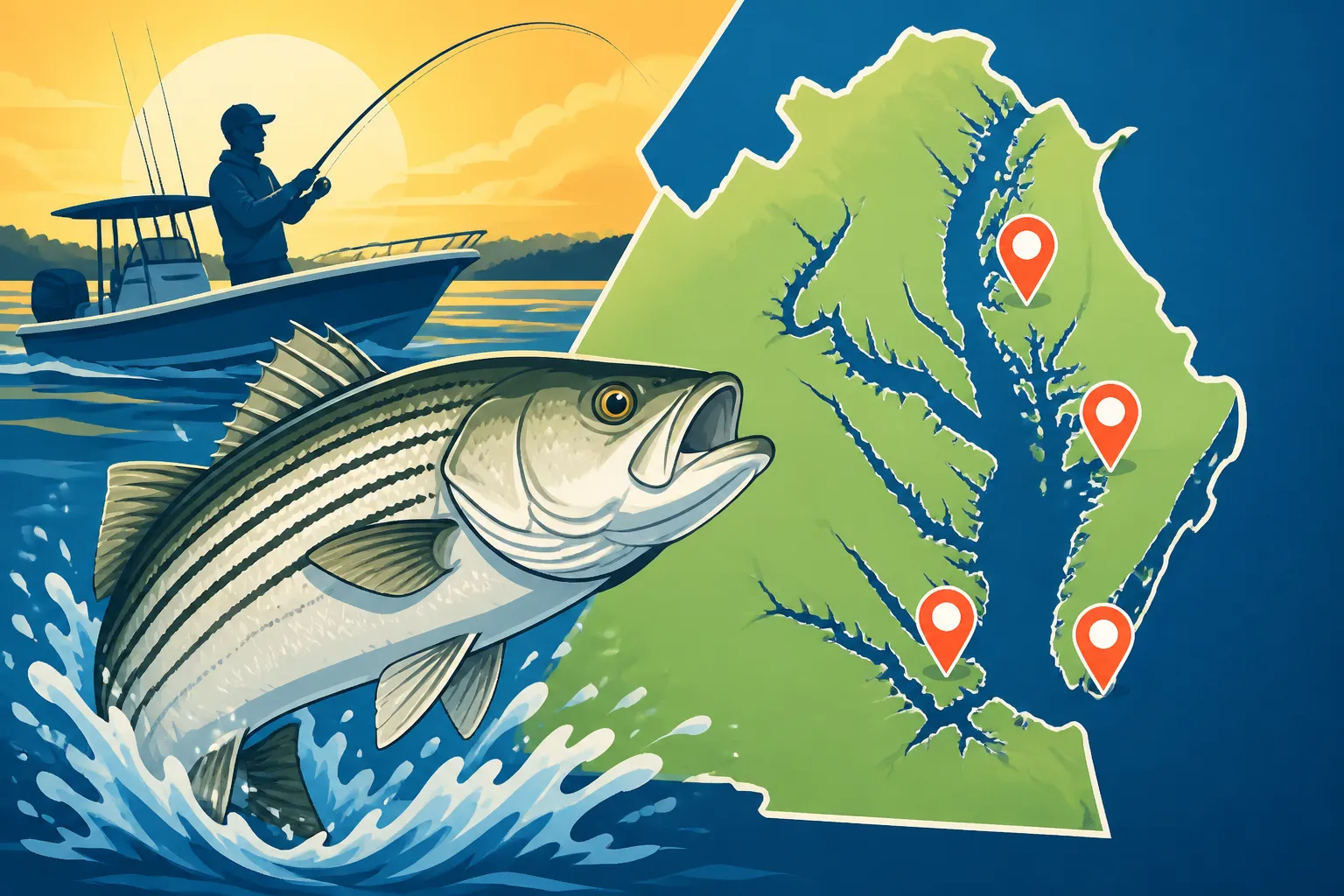
When many anglers think of striped bass in the Virginia portion of the Chesapeake Bay, their minds often go straight to the lower Bay, particularly the area around Virginia Beach and the monumental Chesapeake Bay Bridge-Tunnel (CBBT). This is arguably the most famous and consistently productive area for large stripers, especially during the fall and early winter months when fish are moving in and out of the ocean.
The CBBT itself is a massive artificial reef, providing an incredible amount of structure for baitfish to hide and stripers to ambush. Areas like the "High-Rise" bridge sections, the "Cell," and the various islands attract huge numbers of fish. Anglers here often target stripers by trolling deep-diving lures, live-lining eels, or jigging around the bridge pilings and rock islands. The deep channels leading into and out of the Bay, such as Thimble Shoal Channel, also serve as major migratory highways for these fish. For those less familiar with navigating these waters, a charter service from Virginia Beach can be invaluable, offering expertise and equipment. Many excellent captains are listed on platforms like FishingBooker, providing a hassle-free way to explore these productive grounds, and can be easily found via a search for Virginia Beach Fishing Charters and Trip Costs.
Beyond the CBBT, the adjacent oceanfront waters off Virginia Beach also hold significant numbers of stripers, especially during their coastal migration. Surf anglers can have success, but boat anglers often find the biggest schools a bit further out. These are truly prime locations, offering some of the most exciting striper fishing in the entire Bay. This area is consistently lauded as one of the Best Fishing Spots Near Virginia Beach for good reason.
Mid-Bay – Rivers and Tributaries
Moving further up into the heart of Virginia's Chesapeake Bay, the extensive network of tidal rivers and their tributaries become incredibly important striped bass fisheries, especially during the spring spawn and fall migrations. Rivers like the James, York, Rappahannock, and Potomac offer diverse habitats and unique fishing opportunities, often calmer than the open Bay.
In spring, these rivers are teeming with spawning stripers. Anglers often focus on the deeper channels, ledges, and structure points within these rivers, using live bait or trolling swimbaits and bucktails. The Fishing the James River in Virginia can be particularly productive for both numbers and size during the spring. As the season progresses, some smaller resident stripers might remain, but the bulk of the larger fish move on. The fall is another excellent time when stripers re-enter these rivers, chasing baitfish that are staging before heading out to the ocean.
The Fishing the Rappahannock River in Virginia and Fishing the York River in Virginia are also fantastic options, offering similar patterns of spring spawning runs and fall feeding frenzies. Each river has its own nuances in terms of depth, current, and specific structures that attract fish, so local knowledge or a good chart plotter can be extremely helpful. These tributary fisheries often provide a more intimate angling experience, with scenic views and plenty of action away from the sometimes-crowded main Bay.
Upper Bay – Northern Reaches (Virginia side, near Maryland border)
While much of the "upper Bay" is often associated with Maryland waters, the northernmost sections of Virginia's Chesapeake Bay also contribute to the overall striped bass fishery. These areas, though perhaps less famous than the CBBT, are important feeding grounds and migratory routes, particularly during the shoulder seasons. As stripers move further north in the spring or south in the fall, they traverse these waters.
Key areas to consider in the upper Virginia Bay include the main shipping channels, prominent points, and submerged structures. These areas serve as ambush points for stripers feeding on schools of baitfish. Anglers might find success trolling along channel edges or casting lures towards visible structure. While not typically known for the massive aggregations seen further south, these spots can still yield excellent fishing, especially for those seeking a less pressured environment.
The fishing here can be more nuanced, requiring a keen eye for bait concentrations and subtle changes in bottom contour. Utilizing good sonar and keeping an eye out for bird activity, which often signals baitfish schools being driven to the surface by predatory fish, is crucial. If you're looking for an experienced guide to navigate these specific parts of the Bay, platforms like FishingBooker can connect you with local captains who specialize in these lesser-known, yet highly productive, northern Virginia Bay waters.
Effective Techniques and Tips for Bay Striped Bass
Catching striped bass consistently in the Chesapeake Bay requires more than just knowing where to go; it also demands a solid understanding of the most effective techniques and how to "read" the water. Stripers are opportunists, but they can also be incredibly finicky, so having a diverse toolkit of methods will greatly increase your chances of success.
Trolling, Live Bait, and Lure Selection
Trolling is undeniably one of the most popular and effective methods for covering large areas and locating schools of striped bass in the Chesapeake Bay, particularly for larger fish during the fall and winter. Anglers often deploy a spread of lines, using planers, downriggers, and in-line weights to present lures at various depths. Popular trolling lures include large parachutes, Mojo rigs (heavy bucktails dressed with plastic shad bodies), spoons, and diving crankbaits that imitate baitfish like bunker or menhaden. Varying your speed and making turns can often trigger a strike from following fish.
Live bait fishing, especially with eels, spot, or bunker, is another deadly technique, particularly around structure like the CBBT or submerged reefs. Eels are a classic choice and can be fished on a simple Carolina rig near the bottom. Spot and bunker can be live-lined (fished with minimal weight) or chummed to bring fish closer to the boat. This method is often more patient but can yield some of the largest stripers. For those who prefer casting, heavy jigs, soft plastic paddle tails, and topwater plugs can be incredibly effective when stripers are actively feeding on the surface or concentrated around bait balls. Knowing the Best Bait for Striped Bass in Chesapeake Bay for specific conditions is a game-changer.
Reading the Water and Interpreting Fish Finders
Successfully finding striped bass often comes down to detective work on the water. Stripers are predators, and like all predators, they are where the food is. Therefore, the first step is always to locate baitfish. Keep a sharp eye out for signs of life on the surface: diving birds, especially gulls and terns, are often a dead giveaway that baitfish are being pushed to the surface by stripers or other predatory fish from below. Look for nervous water, splashes, or even full-blown "blitzes" where stripers are actively busting bait on the surface.
Your fish finder is another indispensable tool. Learning How to Find Fish From a Boat With a Fish Finder is crucial. It will help you identify schools of baitfish, locate structure on the bottom (like ledges, wrecks, or bridge pilings), and mark individual or schools of striped bass. Look for arches or dense clouds of bait, and pay attention to fish marks near those bait schools or suspended over structure. Understanding what your sonar is telling you can turn a slow day into a banner one. Many guides, especially those found on FishingBooker, are masters at interpreting sonar and reading the water, offering a valuable learning experience if you book a trip with them. Their local expertise, combined with top-notch electronics, often makes the difference between searching and catching.
Regulations and Responsible Angling
Fishing for striped bass in the Chesapeake Bay is a privilege, and it comes with a responsibility to protect the resource. Striped bass populations have fluctuated significantly over the years, leading to strict regulations designed to ensure the species' sustainability. Understanding and adhering to these rules isn't just about avoiding fines; it's about contributing to the long-term health of one of Virginia's most cherished fisheries.
Understanding Virginia's Striped Bass Rules
The regulations for striped bass in Virginia's Chesapeake Bay are complex and can change annually, or even seasonally, to adapt to stock assessments. It's not enough to simply have a fishing license; you need to know the specific rules for the species you're targeting. For striped bass, this includes length limits (often referred to as "slot limits"), daily possession limits, and specific seasons when fishing is permitted. These rules are put in place by the Virginia DWR and other regulatory bodies to manage the population responsibly.
Before every trip, make it a point to check the latest regulations. The DWR website is always the most accurate source for current rules. For example, Virginia's striped bass fishery often operates with a slot limit, meaning you can only keep fish within a certain size range, such as Virginia's Striped Bass Slot Limit: 28 to 31 Inches. This protects both the juvenile fish and the large, mature spawning fish. Ignorance of the law is never an excuse, and game wardens actively patrol the Bay. Always consult the comprehensive Virginia Fishing Regulations Explained before heading out to ensure you are compliant.
Catch and Release Best Practices
Given the conservation efforts surrounding striped bass, practicing responsible catch and release, especially for fish outside the legal slot limit or during warmer months, is paramount. Striped bass are resilient, but improper handling can cause significant stress or injury, reducing their chances of survival after release.
When releasing fish, minimize the time the fish is out of the water. Use appropriate gear that allows for a quick fight and landing. Circle hooks are highly recommended, as they significantly reduce gut hooking, making release much easier and safer for the fish. If a fish is deeply hooked, cut the line as close to the hook as possible rather than trying to yank the hook out. Support the fish horizontally, especially larger ones, and avoid holding them vertically by the jaw or gills. If possible, revive the fish alongside the boat, holding it gently in the water and allowing water to flow over its gills until it swims away under its own power. Many professional guides, particularly those listed on FishingBooker, are well-versed in these practices and can teach you the best ways to ensure a healthy release, showcasing their commitment to the fishery's future.
Chesapeake Bay Striped Bass Hotspot Summary
To help visualize some of these top-tier striped bass locations and the best times to target them, here's a handy overview. Remember, conditions can change, but these spots are a great starting point for your next Virginia striped bass adventure!
| Location | Key Features | Best Season(s) | Primary Techniques | Target Size | Notes |
|---|---|---|---|---|---|
| Chesapeake Bay Bridge-Tunnel (CBBT) | Artificial reef, deep channels, current, structure | Fall, Winter (early) | Trolling, Live Eel, Jigging | Medium to Large | Prime for trophy fish, requires navigating strong currents |
| James River (lower sections) | Spawning grounds, ledges, channels | Spring, Fall | Trolling, Live Bait, Jigging | Small to Medium, some large | Excellent spring spawn, active fall feeding. Fishing the James River in Virginia |
| York River | Channels, oyster reefs, confluence points | Spring, Fall | Trolling, Casting, Live Bait | Small to Medium | Good for a quieter experience, often holds resident fish. |
| Rappahannock River | Tidal creeks, deep bends, bridge pilings | Spring, Fall | Trolling, Casting, Live Bait | Small to Medium | Popular for spring runs, diverse habitats. |
| Offshore Virginia Beach (near Bay Mouth) | Open ocean, migratory routes, structure (wrecks) | Fall, Winter | Trolling, Live Bait | Large to Trophy | Requires ocean-worthy vessel, can be rough waters. |
Disclaimer
Please note that fishing conditions, regulations, and fish behavior can change rapidly. Always consult the most current Virginia Department of Wildlife Resources (DWR) regulations before any fishing trip. This guide is for informational purposes only and does not guarantee fishing success. Be aware of weather conditions, practice safe boating, and respect private property.